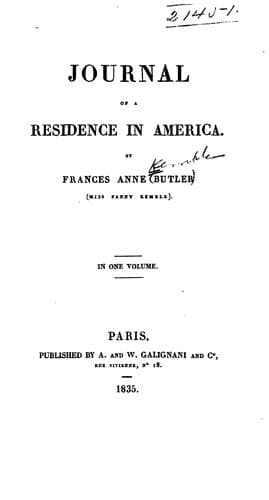
Atlantic States -- Description and travel; Kemble, Fanny, 1809-1893; United States -- Social life and customs -- 1783-1865
Towards the end of supper, we fell into a strange discussion as to the
nature of existence. A vain and fruitless talk, after all; for life
shall be happy or sad, not, indeed, according to its events, but
according to the nature of the individuals to whom these events befall.
Colonel ---- maintained that life was in itself desirable; abounding in
blessings, replete with comforts, a fertile land, where still, as one
joy decays, another springs up to flourish in its place. He said that he
felt thankful every day, and every hour of the day, for his existence;
that he feared death, only because life was an absolute enjoyment, and
that he would willingly, to-morrow, accept the power of beginning his
again, even though he should be placed on the world's threshold, a
lonely friendless beggar: so sure was he that his prospects would
brighten, and friends spring up to him, and plenty reward labour, and
life become pleasant, ere it had grown many years old. How widely human
beings differ! It was but an hour before, that I, in counting how many
stars I had already seen go down below the horizon of existence,--Weber,
Lawrence, Scott, all of whom I have known,--was saying to D----, "How
sad a thing, and strange, life is!" adding, what I repent me for, "I
wish that I were dead!" Oh, how can any human being, who looks abroad
into the world, and within upon himself, who sees the wondrous mystery
of all things, the unabidingness which waits on all matter, the
imperfection which clogs all spirit; who notes the sovereignty of change
over the inanimate creation, of disease, decay, and death over man's
body, of blindness and delusion over his mind, of sin over his soul; who
beholds the frailty of good men; who feels the miserable inconsistency
of his own nature; the dust and ashes of which our love, and what we
love, is made; the evil that, like an unwholesome corpse, still clings
to our good; the sorrow that, like its shadow, still walks behind our
joy;--oh, who that sees all this can say that this life is other than
sad--most sad? Yet, while I write this, God forbid that I should
therefore want eyes to see, or sense to feel, the blessings wherewith he
has blessed it; the rewards with which he sweetens our task, the flowers
wherewith he cheers our journey's road, the many props wherewith he
supports our feet in it. Yet of all these, the sweetest, the brightest,
the strongest, are those which our soul draws from him, the end of its
desire, not those it finds here. And how should not that spirit yearn
for its accomplishment? If we seek knowledge here, a thousand mists
arise between our incapable senses and the truth, how, then, should we
not wish to cast away this darkness, and soar to the fountains of all
light? If we strive to employ those faculties which, being of our soul,
have the strength and enduring of immortality, the objects whereon we
expend them here are vague, evanescent, disappointing; how then should
Public-domain text, read in full here on John Shaqi.
Reviews
Reviews
No reviews yet
Be the first to share your thoughts on this work.
Elsewhere in the archive
Join the Discussion
Join the discussion
Sign in to leave a comment or review.
Sign InorCreate an account