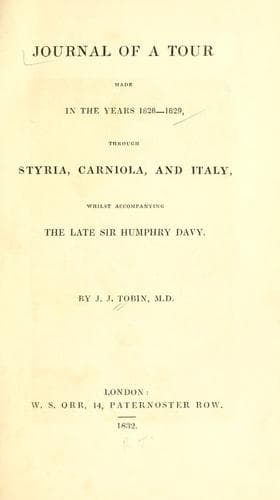
Journal of a Tour in the Years 1828-1829, through Styria, Carniola, and Italy, whilst Accompanying the Late Sir Humphry DavyTobin, J. J.
History
Journal of a Tour in the Years 1828-1829, through Styria, Carniola, and Italy, whilst Accompanying the Late Sir Humphry Davy
Tobin, J. J.
Davy, Humphry, Sir, 1778-1829; Europe -- Description and travel
_10th._ We quitted Lucca at seven in the morning, and from the top
of the hill beyond it, I discovered the straight blue line of the
Mediterranean. Descending the hill, and driving about ten miles through
groves of olives and rows of poplars, from which the vines hung down in
long single festoons, we passed the boundary of the Lucchese territory,
and entered the small dukedom of Massa-Carrara, and shortly after into
the town of Massa, a neat and airy though old town. White marble is
generally used here for the stairs, and for the facings of the doors
and windows. Whilst dinner was preparing, I took a walk up to the old
castle above the town, now emphatically called _the fortress_. Its
only garrison, however, seemed to consist of four or five soldiers,
who were provided with one old rusty cannon. The view from the ruined
battlements was highly beautiful: in front lay the wide sea, glancing
in the beams of the sun, so bright that the eye could not bear to look
upon it; to the left, in the distance, appeared the island of Gorgona,
rising like a dark blue rock out of the glittering waves; to the right,
two smaller islands were seen, beyond which appeared promontory upon
promontory, conveying their woods of olives far out into the sea.
Below the castle a vast plain covered with vineyards and groves of
olives was seen, stretching down to the edge of the water, intersected
by a silvery river winding among the trees, whilst immediately under
the hill, and half hidden by it, lay Massa, like the plan of a town
spread open before me. Beyond it were seen the wooded hills leading to
Carrara, and behind the castle rose rocky and rugged mountains, here
and there spotted with a field or two of remaining snow, and, like the
Alps, hiding their lofty heads in dark grey clouds.
Quitting Massa, we drove over a noble bridge of one lofty arch built
entirely of white marble, and after winding across a long hill, we
passed through Carrara, near which, in one of the lateral vallies, are
the celebrated marble quarries. A little beyond this village we entered
the Piedmontese territory and the dominions of the King of Sardinia,
and soon arrived at Sarzana, a small ill-looking town. It being Sunday,
the road and town were covered with peasants in their holiday suits:
the dress of the women is one of the oddest I have yet seen; they wear
no stockings, and their clothes seem huddled on all in a bundle; their
hair is drawn away from their foreheads, and tied up behind in a bag of
silk, of different colours, some red, some blue, some black, and always
with three or four tassels hanging down from the end, whilst on the top
of this bag is stuck the funniest little straw hat possible, looking
much like a soup plate turned topsy-turvy, and made of frizzled straw,
ornamented with coloured ribbons. The women of a higher rank wear white
veils over their heads, and no bags.
Public-domain text, read in full here on John Shaqi.
Reviews
Reviews
No reviews yet
Be the first to share your thoughts on this work.
Elsewhere in the archive
Join the Discussion
Join the discussion
Sign in to leave a comment or review.
Sign InorCreate an account