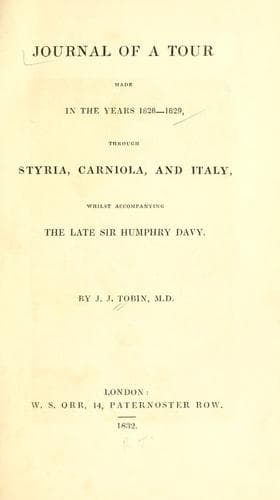
Journal of a Tour in the Years 1828-1829, through Styria, Carniola, and Italy, whilst Accompanying the Late Sir Humphry DavyTobin, J. J.
History
Journal of a Tour in the Years 1828-1829, through Styria, Carniola, and Italy, whilst Accompanying the Late Sir Humphry Davy
Tobin, J. J.
Davy, Humphry, Sir, 1778-1829; Europe -- Description and travel
_29th May._ I quitted Sir Humphry yesterday evening, after having read
to him as usual, since we left Rome, till about ten o'clock. Our book
was Smollet's "Humphry Clinker," and little did I think it was the last
book he would ever listen to. He seemed in tolerable spirits, but upon
going to bed was seized with spasms, which, however, were not violent,
and soon ceased. I left him when in bed, and bidding me "Good night,"
he said I should see him better in the morning.
Lady Davy and the Doctor also quitted him, and George went to bed in
his master's room, as he always had done since Sir Humphry's illness
at Rome. At six o'clock this morning, Lady Davy's man-servant came to
my room, and told me that Sir Humphry Davy was no more. I replied that
it was impossible, and that he probably only lay in a torpor; but I
went down to his room instantly, when I found that the servant's words
were, alas! but too true. I asked George why he had not called me, when
he said that he had sent up, but now found that it had been to a wrong
room. He told me that Sir Humphry went to sleep after we had left him,
but that he had twice waked, and that at half-past one, hearing him
get out of bed, he went to him, when Sir Humphry said he did not want
his assistance, and poured some solution of acetate of morphine into a
wine glass of water; but this still remained untouched upon his table.
George then helped him into bed, where he says he lay quite still till
a little after two o'clock, when hearing him groan, he went to him,
and found that he was senseless and expiring. He instantly called up
Lady Davy and the Doctor, and sent up, as he believed, to me; but Sir
Humphry, he says, never spoke again, and expired without a sigh.
I had so often, whilst at Rome, seen Sir Humphry lie for hours together
in a state of torpor, and to all appearance dead, that it was difficult
for me to persuade myself of the truth; but the delusion at length
vanished, and it became too evident that all that remained before me
of this great philosopher, was merely the cold and senseless frame
with which he had worked. The animating spirit had fled to its oft
self-imagined planetary world, there to join the rejoicing souls of the
great and good of past ages, soaring from system to system, and with
them still to do good in a higher and less bounded sphere, and I knew
that it was freed from many a wearisome and painful toil: yet I could
not look upon Sir Humphry as he was, without remembering that which he
had been, and my tears would fall, spite of my effort to restrain them.
THE END.
FOOTNOTES:
[A] A Calvary is a representation of the Crucifixion of our Saviour,
consisting of one, and often of three large crosses, with accompanying
figures and decorations.
[B] This word means in Krainerisch, a rotten or broken tooth, and is
applied in this sense to the jagged summits of the mountain.
Public-domain text, read in full here on John Shaqi.
Reviews
Reviews
No reviews yet
Be the first to share your thoughts on this work.
Elsewhere in the archive
Join the Discussion
Join the discussion
Sign in to leave a comment or review.
Sign InorCreate an account