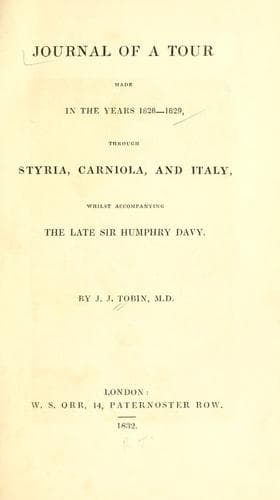
Journal of a Tour in the Years 1828-1829, through Styria, Carniola, and Italy, whilst Accompanying the Late Sir Humphry DavyTobin, J. J.
History
Journal of a Tour in the Years 1828-1829, through Styria, Carniola, and Italy, whilst Accompanying the Late Sir Humphry Davy
Tobin, J. J.
Davy, Humphry, Sir, 1778-1829; Europe -- Description and travel
_10th._ The first thing I did this morning was to call upon Count W----
for Sir Humphry, in order to obtain permission for him to shoot in the
neighbourhood. The Count was not in Salzburg, but I easily obtained
leave from the person who acted for him during his absence. Sir Humphry
accordingly immediately started for the neighbouring marshes, and I
occupied the morning in seeing the town. The most remarkable object is
the _Neu Thor_, the New Gate, a stupendous undertaking, which may stand
comparison with any of the works of the ancient Romans. It is formed of
one long arch, or rather tunnel, some hundred feet in length, between
twenty to thirty in breadth, and thirty to forty feet in height, cut
through the wall of rock, which surrounds the town on the Bavarian
side. On the outside the rock is handsomely sculptured, and forms a
very elegant entrance into this long passage. This work was commenced
at the beginning of the last century, and forty years elapsed ere it
was completed. Another work of a similar kind is the summer riding
school, a large amphitheatre, the galleries of which are cut out of the
solid rock. From hence I crossed over the Salzache into the new town,
to visit the church of St. Sebastian, which contains the monument of
the celebrated Theophrastus Paracelsus. It is very simple, and formed
of the red brown marble of the country. It bears his head in relief,
and the following inscription, which is a proof of the great esteem in
which the memory of this famous quack was held even till the middle of
the eighteenth century.
"Philippi Theophrasti Paracelsi qui tantam orbis famam ex auro chymico
adeptus est effigia et ossa donec rursus circumdabuntur pelle sua sub
reparatione ecclesiæ MDCCLII. ex sepulchrali tabe eruta heic locata
sunt.
"Conditur hic Philippus Theophrastus insignis medicinæ doctor, qui
dira illa vulnera, lepram, podagram, hydropsin, aliaque insanabilia
corporis contagia mirifica arte sustulit, ac bona sua in pauperes
distribuenda collocandaque honoravit.
"Anno MDXXI. die XXIII Septembris vitam cum morte mutavit."
On my return I passed by the house in which he died, and on the outside
of it there is still a painting of him, and a nearly obliterated
inscription. From hence I went to the church of St. Peter, in the old
town, to see the tomb of Haydn; but unfortunately found the church
closed, and could not see the monument.
The cathedral church of St. Rupert is a fine building in the Italian
style of architecture. It is built partly of free-stone and partly
of marble. The streets of Salzburg, with the exception of the chief
street, are narrow and generally ill paved, but the houses are clean
and neat, and of a great height. The palace of the former archbishop
is a spacious and magnificent building, and before it is a beautiful
fountain. Besides its public buildings, Salzburg has many large and
elegant private houses.
Public-domain text, read in full here on John Shaqi.
Reviews
Reviews
No reviews yet
Be the first to share your thoughts on this work.
Elsewhere in the archive
Join the Discussion
Join the discussion
Sign in to leave a comment or review.
Sign InorCreate an account