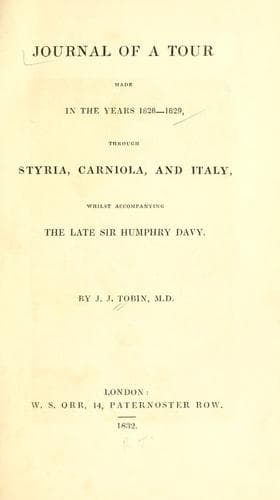
Journal of a Tour in the Years 1828-1829, through Styria, Carniola, and Italy, whilst Accompanying the Late Sir Humphry DavyTobin, J. J.
History
Journal of a Tour in the Years 1828-1829, through Styria, Carniola, and Italy, whilst Accompanying the Late Sir Humphry Davy
Tobin, J. J.
Davy, Humphry, Sir, 1778-1829; Europe -- Description and travel
_7th._ Early this morning I went with two students from Munich, whom I
met on their road to Adelsberg, to see the source of the river. At the
end of a romantic glen, surrounded by fine rocks and wood, the river
oozes out of the hill, forming a large pond, which falls over a natural
dam in front, and is then joined, a few hundred yards below, by another
subterraneous stream, and they together form a tolerably large river.
Parting here from my Munich companions, I returned to Oberlaibach,
when I found Sir Humphry was already gone out shooting, but he shortly
returned, and having shot nothing, we set out for Planina. Immediately
upon leaving Oberlaibach we ascended a very long and steep hill, the
surface of which was everywhere perforated with large conical pits,
much resembling funnels, affording a striking example of that species
of country called by geologists funnel land. Arrived at the top of the
hill we found ourselves in a wide fertile valley, through which we saw
the Laibach winding slowly, till on reaching the end of the valley it
disappears in the fields, and after pursuing its subterraneous course
through the mountain, again rises to the surface near Ober-Laibach.
We stopped to bait the horses at Loitsch, and then drove on through
the valley to Planina, a dirty village, where we passed the night in a
miserable inn.
[Illustration: From nature _by J. J. Tobin_ TRIESTE]
_8th._ Leaving Planina early this morning, we ascended a very steep
hill, at the foot of which the Laibach again rises out of the mountains
as it does at Ober-Laibach. The country between Planina and Adelsberg
is bleak and barren, and presents nothing interesting. The mountain
near the latter small town contains the famous grottos of Adelsberg,
formerly thought to be the only spot where that singular animal the
_Proteus Anguinus_ was found. Sir Humphry said there was no time for
me to visit these grottos now, but he thought that he should pass
through Adelsberg again upon his return, and we accordingly drove into
Trewalchen, where we passed over another long and steep hill. At Sesana
we saw the first olive trees; they much resemble the common willow, but
are darker; these and the flat-roofed houses, and a lighter and more
airy style of architecture, told us that we were approaching Italy.
The country between Sesana and Trieste is wild and bleak, completely
covered with broken and waterworn rocks, over which, ages ago, some
great current of the ocean must have passed, and thus occasioned their
present singular and often fantastic shapes. At the foot of the last
hill, which is not steep, we entered the territory of Trieste, and
from its summit one of the most magnificent sea views I ever beheld
burst upon our sight. Nearly two thousand feet below us lay the wide
expanse of the blue Adriatic, its light waves glittering in the
sun-beams, occasionally shaded by the intercepting clouds. At the foot
of the mountain, and partly concealed by it, appeared Trieste, with
Public-domain text, read in full here on John Shaqi.
Reviews
Reviews
No reviews yet
Be the first to share your thoughts on this work.
Elsewhere in the archive
Join the Discussion
Join the discussion
Sign in to leave a comment or review.
Sign InorCreate an account