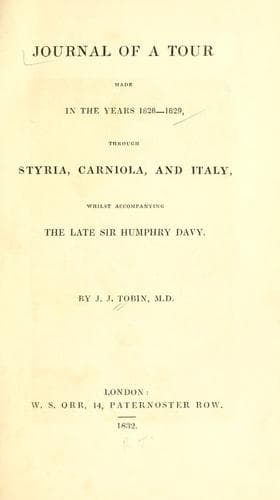
Journal of a Tour in the Years 1828-1829, through Styria, Carniola, and Italy, whilst Accompanying the Late Sir Humphry DavyTobin, J. J.
History
Journal of a Tour in the Years 1828-1829, through Styria, Carniola, and Italy, whilst Accompanying the Late Sir Humphry Davy
Tobin, J. J.
Davy, Humphry, Sir, 1778-1829; Europe -- Description and travel
_8th._ To-day we were near being burnt out of our lodging. On awaking
in the morning, I found my room and the drawing-room filled with smoke,
and perceived a strong smell of burning wood. The servant said that all
the windows had been opened for upwards of an hour, and yet he could
not get rid of the smoke. We could, however, discover nothing, till the
lodgers from below sent up to say that fire was falling through their
ceiling, and upon going into their room I found the ceiling on fire,
and that a large hole was already burnt through the beams which lay
immediately under Sir Humphry's fire-place. I instantly sent for the
fire-men, who did their business very expertly, taking up the floor of
Sir Humphry's drawing-room, which they found burning for a considerable
space round the hearth, upon which so large a fire had been kept up the
day before, that the heat had penetrated through the stone, and thus
set fire to the beams. In an hour it was quite extinguished, and all
danger over. To avoid the bustle occasioned by the reparation required,
Sir Humphry determined to visit the Lago di Solfatara, sometimes called
the lake of the swimming islets, and he begged me to accompany him: we
therefore set out immediately, and left Rome by the Porta St. Lorenzo,
and following the ancient Via Tibertina, we crossed, about four
miles from Rome, the Aniene, or, as it is more generally called, the
Teverone, a small river, which forms the celebrated cascades at Tivoli.
On many parts of the road the remains of the ancient Roman pavement
are very distinct, formed of large round or octangular flat stones.
About thirteen miles from Rome we reached the little bridge across the
stream which runs from the lake of Solfatara. Leaving the carriage
here, Sir Humphry mounted his pony, and, turning off to the left across
the fields, we soon reached the Lago. It is a small bason of water,
of an oval form, and measures in its greatest diameter not more than
two hundred yards, but its depth is said to be about two hundred feet.
The colour of the water is bluish white, and from the quantity of lime
which it holds in solution is by no means clear. The surface appears
to be in a state of considerable ebullition, which is caused by the
quantity of air that escapes through it, and on flinging in a stone the
water bubbles up violently at the spot where it falls. The temperature,
however, is far below that of boiling water, for on trying it to the
depth of six feet in different places, we found it vary between 85°
and 87° Fahrenheit. It continually emits a strong smell of sulphurated
hydrogen, which is perceptible upon the high road sometime before one
arrives at the Lago. The floating islands, which have contributed to
render this lake celebrated, are no fable, and are easily explained.
Around it and upon it are numerous species of _confervæ_ and many small
water plants, which, becoming encrusted with the carbonate of lime
Public-domain text, read in full here on John Shaqi.
Reviews
Reviews
No reviews yet
Be the first to share your thoughts on this work.
Elsewhere in the archive
Join the Discussion
Join the discussion
Sign in to leave a comment or review.
Sign InorCreate an account