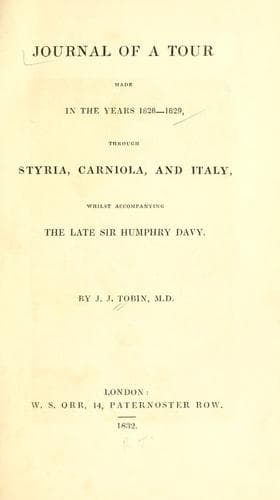
Journal of a Tour in the Years 1828-1829, through Styria, Carniola, and Italy, whilst Accompanying the Late Sir Humphry DavyTobin, J. J.
History
Journal of a Tour in the Years 1828-1829, through Styria, Carniola, and Italy, whilst Accompanying the Late Sir Humphry Davy
Tobin, J. J.
Davy, Humphry, Sir, 1778-1829; Europe -- Description and travel
V'é chi a Todini oppone
La morte di Leone;
Roma però sostiene
Ch 'egli à operato bene.
And again--
Alle dieci di Febraro,
E successo un caso raro,
A un Leon creduto forte
Diede un asino la morte.
_16th._ To-day I made an excursion to Tivoli, with Hofrath F---- of
Darmstadt, whom I had met a day or two before by mere chance, in the
street, and who kindly greeted me as an old friend. We followed the
same road which I had passed over with Sir Humphry when we visited
the Solfatara; and about two miles beyond the little bridge over the
canal, we again crossed the Teverone, by the Ponte Lucano, near which
is the sepulchre of the Plautian family, built of travertine, in the
shape of a round tower, and on the front of it are still the remains
of some columns and Latin inscriptions. Three or four miles beyond
this monument lies Tivoli, where we arrived about ten o'clock in the
morning, having quitted Rome at an early hour, and we occupied the
whole morning in viewing the ruins and cascades. Our first visit was
to the Temple of Vesta, generally called the Temple of the Sybil, a
beautiful and elegant ruin, situated immediately above the Falls of the
Aniene. It is of a circular form, and appears to have been surrounded
by eighteen columns, ten of which are still remaining. These columns
are of travertine, and of the Corinthian order. Close to this temple
stands another small one, which is said to have been dedicated to the
Tiburtine Sybil, of a square form, with four Ionic columns in front.
Descending near this temple, a very good path led us down to the
Grotto of Neptune, into which the waters of the Aniene precipitate
themselves with impetuosity, forming on two sides beautiful cascades,
which fall into the same pool, and run from it through a very narrow
and highly picturesque valley, round the hill upon which Tivoli is
situated. Leaving the grotto and town, we walked along the side of
the mountains which look towards the _campagna_ and Rome; and during
our walk, our guide showed us the remains and situations of some of
the most celebrated villas; the country-house of the poet Catullus,
and that of Horace and Quintillius Varo. Before we ascended to the
villa of Mæcenas, we passed by the _Cascatelle_, beautiful and highly
picturesque falls, which seem to rise out of the town of Tivoli, and
leap down the hill into the valley in many a varied bound. The villa
of Mæcenas is now used as an iron manufactory; many of the rooms and
corridors are still distinct, and the roof is still perfect. The view
from hence towards Rome is magnificent, embracing the whole _campagna_,
with the different towns and villages in it, and is bounded by the
cupola of St. Peter's. The Villa d'Este is of modern architecture, and
Public-domain text, read in full here on John Shaqi.
Reviews
Reviews
No reviews yet
Be the first to share your thoughts on this work.
Elsewhere in the archive
Join the Discussion
Join the discussion
Sign in to leave a comment or review.
Sign InorCreate an account