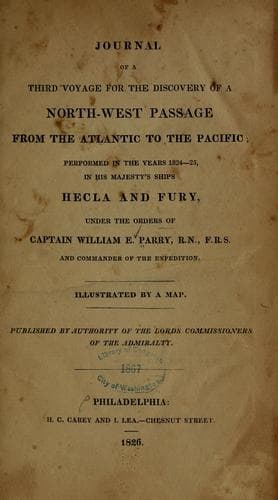
Journal of the Third Voyage for the Discovery of a North-West PassageParry, William Edward, Sir
History
Journal of the Third Voyage for the Discovery of a North-West Passage
Parry, William Edward, Sir
Arctic regions -- Discovery and exploration -- British; Fury (Ship); Hecla (Ship); Northwest Passage
In what has been hitherto said, regard has been had only to their
dealings with us. In their transactions among themselves there is no
doubt that, except in one or two privileged cases, such as that of
destitute widows, the strictest honesty prevails, and that as regards the
good of their own community they are generally honest people. We have in
numberless instances sent presents by one to another, and invariably
found that they had been faithfully delivered. The manner in which their
various implements are frequently left outside their huts is a proof,
indeed, that robbery is scarcely known among them. It is true that there
is not an article in the possession of one of them of which any of the
rest will not readily name the owner, and the detection of a theft would
therefore be certain and immediate. Certainty of detection, however,
among a lawless and ferocious people, instead of preventing robbery,
would more probably add violence and murder to the first crime, and the
strongest would ultimately gain the upper hand. We cannot, therefore,
but admire the undisturbed security in which these people hold their
property without having recourse to any restraint beyond that which is
incurred by the tacitly received law of mutual forbearance.
In the barter of their various commodities their dealings with us were
fair and upright, though latterly they were by no means backward or
inexpert in driving a bargain. The absurd and childish exchanges which
they at first made with our people induced them subsequently to complain
that the Kabloonas had stolen their things, though the profit had been
eventually a hundredfold in their favour. Many such complaints were made
when the only fault in the purchaser had been excessive liberality, and
frequently also as a retort by way of warding off the imputation of some
dishonesty of their own. A trick not uncommon with the women was to
endeavour to excite the commiseration and to tax the bounty of one person
by relating some cruel theft of this kind that had, as they said, been
practised upon them by another. One day, after I had bought a knife of
Togolat, she told Captain Lyon, in a most piteous tone, that _Parree_ had
stolen her last _ooloo_, that she did not know what to do without one,
and, at length coming to the point, begged him to give her one.
Presently after this, her husband coming in and asking for something to
eat, she handed him some meat accompanied by a very fine ooloo. Her son,
being thus reminded of eating, made the same request, upon which a second
knife was produced, and immediately after, a third of the same kind for
herself. Captain Lyon, having amused himself in watching these
proceedings, which so well confirmed the truth of the proverb that
certain people ought to have good memories, now took the knives, one by
one, out of their hands, and holding them up to Togolat, asked her if
Parree had not stolen her last ooloo. A hearty laugh all round was the
Public-domain text, read in full here on John Shaqi.
Reviews
Reviews
No reviews yet
Be the first to share your thoughts on this work.
Elsewhere in the archive
Join the Discussion
Join the discussion
Sign in to leave a comment or review.
Sign InorCreate an account