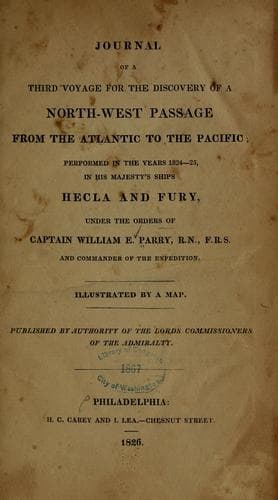
Journal of the Third Voyage for the Discovery of a North-West PassageParry, William Edward, Sir
History
Journal of the Third Voyage for the Discovery of a North-West Passage
Parry, William Edward, Sir
Arctic regions -- Discovery and exploration -- British; Fury (Ship); Hecla (Ship); Northwest Passage
The estimation in which women are held among these people is, I think,
somewhat greater than is usual in savage life. In their general
employments they are by no means the drudges that the wives of the
Greenlanders are said to be; being occupied only in those cares which may
properly be called domestic, and as such are considered the peculiar
business of the women among the lower classes in civilised society. The
wife of one of these people, for instance, makes and attends the fire,
cooks the victuals, looks after the children, and is sempstress to her
whole family; while her husband is labouring abroad for their
subsistence. In this respect it is not even necessary to except their
task of cutting up the small seals, which is, in truth, one of the
greatest luxuries and privileges they enjoy; and even if it were esteemed
a labour, it could scarcely be considered equivalent to that of the women
in many of our own fishing-towns, where the men’s business is at an end
the moment the boat touches the beach. The most laborious of their tasks
occurs perhaps in making their various journeys, when all their goods and
chattels are to be removed at once, and when each individual must
undoubtedly perform a full share of the general labour. The women are,
however, good walkers, and not easily fatigued; for we have several times
known a young woman of two-and-twenty, with a child in her hood, walk
twelve miles to the ships and back again the same day for the sake of a
little bread-dust and a tin canister. When stationary in the winter,
they have really almost a sinecure of it, sitting quietly in their huts,
and having little or no employment for the greater part of the day. In
short, there are few, if any, people in this state of society among whom
the women are so well off. They always sit upon the beds with their legs
doubled under them, and are uneasy in the posture usual with us. The men
sometimes sit as we do, but more generally with their legs crossed before
them.
Public-domain text, read in full here on John Shaqi.
Reviews
Reviews
No reviews yet
Be the first to share your thoughts on this work.
Elsewhere in the archive
Join the Discussion
Join the discussion
Sign in to leave a comment or review.
Sign InorCreate an account