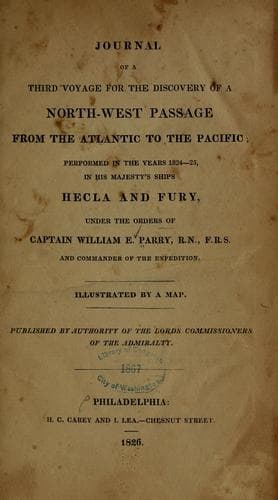
Journal of the Third Voyage for the Discovery of a North-West PassageParry, William Edward, Sir
History
Journal of the Third Voyage for the Discovery of a North-West Passage
Parry, William Edward, Sir
Arctic regions -- Discovery and exploration -- British; Fury (Ship); Hecla (Ship); Northwest Passage
“About the month of September the approach of winter induced the
Esquimaux at Igloolik to abandon their tents and to retire into their
more established village. The majority were here crowded into huts of a
permanent construction, the materials composing the sides being stones
and the bones of whales, and the roofs being formed of skins, turf, and
snow; the rest of the people were lodged in snow-huts. For a while they
continued very healthy; in fact, as long as the temperature of the
interior did not exceed the freezing-point, the vapours of the atmosphere
congealed upon the walls, and the air remained dry and tolerably pure;
besides, their hard-frozen winter stock of walrus did not at this time
tempt them to indulge their appetites immoderately. In January the
temperature suffered an unseasonable rise, some successful captures of
walrus also took place, and these circumstances, combined perhaps with
some superstitious customs, of which we were ignorant, seemed the signal
for giving way to sensuality. The lamps were accumulated and the kettles
more frequently replenished, and gluttony in its most disgusting form
became for a while the order of the day. The Esquimaux were now seen
wallowing in filth, while some surfeited lay stretched upon their skins
enormously distended, and with their friends employed in rolling them
about to assist the operations of oppressed nature. The roofs of their
huts were no longer congealed, but dripping with wet and threatening
speedy dissolution. The air was in the bone-huts damp, hot, and, beyond
sufferance, offensive with putrid exhalations from the decomposing relics
of offals, or other animal matter, permitted to remain from year to year
undisturbed in these horrible sinks.
“What the consequences might have been had this state of affairs long
continued, it is not difficult to imagine; but, fortunately for them, an
early and gradual dispersion took place, so that by the end of January
few individuals were left in the village. The rest, in divided bodies,
established themselves in snow-huts upon the sea-ice at some distance
from the land. Before this change had been completed, disorders of an
inflammatory character had appeared. A few went away sick, some were
unable to remove, and others taken ill upon the ice, and we heard of the
death of several about this period.
“The cold snow-huts into which they had moved, though infinitely
preferable to those abandoned, were ill-suited to the reception of people
already sick or predisposed, from the above-named causes, to sickness;
many of them were also deficient in clothing to meet the rigorous weather
that followed. Nevertheless, after this violent excitement had passed
away, a comparatively good condition of health was enjoyed for the
remainder of the winter and spring months.
Public-domain text, read in full here on John Shaqi.
Reviews
Reviews
No reviews yet
Be the first to share your thoughts on this work.
Elsewhere in the archive
Join the Discussion
Join the discussion
Sign in to leave a comment or review.
Sign InorCreate an account