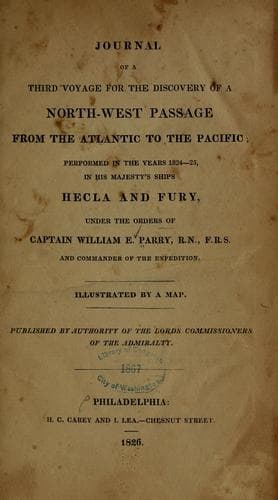
Journal of the Third Voyage for the Discovery of a North-West PassageParry, William Edward, Sir
History
Journal of the Third Voyage for the Discovery of a North-West Passage
Parry, William Edward, Sir
Arctic regions -- Discovery and exploration -- British; Fury (Ship); Hecla (Ship); Northwest Passage
while the sails were setting, the ice, which had at first been about
three-quarters of a mile distant from us, was observed to be closing the
shore. The ships were cast with all expedition, in hopes of gaining the
broader channel before the ice had time to shut us up. So rapid,
however, was the latter in this its sudden movement, that we had but just
got the ships’ heads the right way, when the ice came bodily in upon us,
being doubtless set in motion by a very sudden freshening of the wind
almost to a gale in the course of a few minutes. The ships were now
almost instantly beset, and in such a manner as to be literally helpless
and unmanageable. In such cases, it must be confessed that the exertions
made by heaving at hawsers or otherwise are of little more service than
in the occupation they furnish to the men’s minds under circumstances of
difficulty; for when the ice is fairly acting against the ship, ten times
the strength and ingenuity could in reality avail nothing.
The sails were, however, kept set, and as the body of ice was setting to
the southward withal, we went with it some little distance in that
direction. The _Hecla_ after thus driving, and now and then forcing her
way through the ice, in all about three-quarters of a mile, quite close
to the shore, at length struck the ground forcibly several times in the
space of a hundred yards, and being then brought up by it remained
immovable, the depth of water under her keel abaft being sixteen feet, or
about a foot less than she drew. The _Fury_ continuing to drive was now
irresistibly carried past us, and we escaped, only by a few feet, the
damage invariably occasioned by ships coming in contact under such
circumstances. She had, however, scarcely passed us a hundred yards when
it was evident, by the ice pressing her in, as well as along the shore,
that she must soon be stopped like the _Hecla_; and having gone about two
hundred yards farther she was observed to receive a severe pressure from
a large floe-piece forcing her directly against a grounded mass of ice
upon the beach. After setting to the southward for an hour or two longer
the ice became stationary, no open water being anywhere visible from the
mast-head, and the pressure on the ships remaining undiminished during
the day. Just as I had ascertained the utter impossibility of moving the
_Hecla_ a single foot, and that she must lie quite aground fore and aft
as soon as the tide fell, I received a note from Captain Hoppner
informing me that the _Fury_ had been so severely “nipped” and strained
as to leak a good deal, apparently about four inches an hour; that she
was still heavily pressed both upon the ground and against the large mass
of ice within her; that the rudder was at present very awkwardly
situated; and that one boat had been much damaged. As the tide fell the
_Fury’s_ stern, which was aground, was lifted several feet, and the
_Hecla_ at low water having sewed five feet forward and two abaft, we
Public-domain text, read in full here on John Shaqi.
Reviews
Reviews
No reviews yet
Be the first to share your thoughts on this work.
Join the Discussion
Join the discussion
Sign in to leave a comment or review.
Sign InorCreate an account