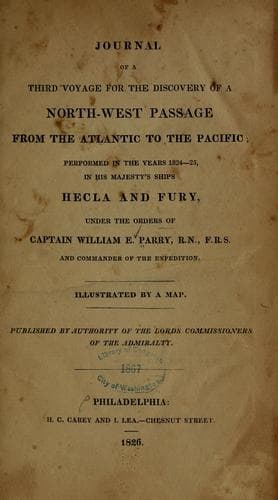
Journal of the Third Voyage for the Discovery of a North-West Passage — John Shaqi
Journal of the Third Voyage for the Discovery of a North-West PassageParry, William Edward, Sir
History
Journal of the Third Voyage for the Discovery of a North-West Passage
Parry, William Edward, Sir
Arctic regions -- Discovery and exploration -- British; Fury (Ship); Hecla (Ship); Northwest Passage
The time of high water, near the opposition of the moon this night, was
between half-past eleven and midnight, being nearly the same as at Port
Bowen at full and change.
The ice opening for a mile and a half along shore on the 30th, we shifted
the _Hecla’s_ berth about that distance to the southward, chiefly to be
enabled to see more distinctly round a point which before obstructed our
view, though our situation, as regarded the security of the ship, was
much altered for the worse. The _Fury_ remained where she was, there
being no second berth even so good as the bad one where she was now
lying. In the afternoon it blew a hard gale, with constant rain, from
the northward, the clouds indicating an easterly wind in other parts.
This wind, which was always the troublesome one to us, soon brought the
ice closer and closer, till it pressed with very considerable violence on
both ships, though the most upon the _Fury_, which lay in a very exposed
situation. The _Hecla_ received no damage but the breaking of two or
three hawsers, and a part of her bulwark torn away by the strain upon
them. In the course of the night we had reason to suppose, by the
_Fury’s_ heeling, that she was either on shore, or still heavily pressed
by the ice from without. Early on the morning of the 31st, as soon as a
communication could be effected, Captain Hoppner sent to inform me that
the _Fury_ had been forced on the ground, where she still lay; but that
she would probably be hove off without much difficulty at high water,
provided the external ice did not prevent it. I also learned from
Captain Hoppner that a part of one of the propelling wheels had been
destroyed, the chock through which its axis passed being forced in
considerably, and the palm broken off one of the bower anchors. Most of
this damage, however, was either of no very material importance, or could
easily be repaired. A large party of hands from the _Hecla_ being sent
round to the _Fury_ towards high water, she came off the ground with very
little strain, so that, upon the whole, considering the situation in
which the ships were lying, we thought ourselves fortunate in having
incurred no very serious injury. The _Fury_ was shifted a few yards into
the best place that could be found, and the wind again blowing strong
from the northward, the ice remained close about us. A shift of wind to
the southward in the afternoon at length began gradually to slacken it,
but it was not till six A.M. on the 1st of August that there appeared a
prospect of making any progress. There was, at this time, a great deal
of water to the southward, but between us and the channel there lay one
narrow and not very close stream of ice touching the shore. A shift of
wind to the northward determined me at once to take advantage of it, as
nothing but a free wind seemed requisite to enable us to reach this
promising channel. The signal to that effect was immediately made, but
Public-domain text, read in full here on John Shaqi.
Reviews
Reviews
No reviews yet
Be the first to share your thoughts on this work.
Join the Discussion
Join the discussion
Sign in to leave a comment or review.
Sign InorCreate an account