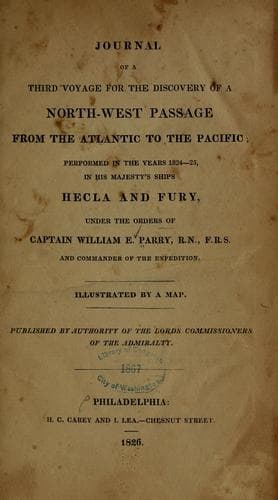
Journal of the Third Voyage for the Discovery of a North-West PassageParry, William Edward, Sir
History
Journal of the Third Voyage for the Discovery of a North-West Passage
Parry, William Edward, Sir
Arctic regions -- Discovery and exploration -- British; Fury (Ship); Hecla (Ship); Northwest Passage
presented altogether no very pleasing or comfortable spectacle. However,
about high water, the ice very opportunely slacking, the _Hecla_ was hove
off with great ease, and warped to a floe in the offing to which we made
fast at midnight. The _Fury_ was not long after us in coming off the
ground, when I was in hopes of finding that any twist or strain, by which
her leaks might have been occasioned, would, in some measure, have closed
when she was relieved from pressure and once more fairly afloat. My
disappointment and mortification, therefore, may in some measure be
imagined, at being informed by telegraph, about two A.M. on the 2nd, that
the water was gaining on two pumps, and that a part of the doubling had
floated up. The _Hecla_ having in the mean time been carried two or
three miles to the southward, by the ice which was once more driving in
that direction, I directed Captain Hoppner by signal to endeavour to
reach the best security in-shore which the present slackness of the ice
might permit, until it was possible for the _Hecla_ to rejoin him.
Presently after perceiving from the mast-head something like a small
harbour nearly abreast of us, every effort was made to get once more
towards the shore. In this the ice happily favoured us, and after making
sail and one or two tacks we got in with the land, when I left the ship
in a boat to sound the place and search for shelter. I soon had the
mortification to find that the harbour which had appeared to present
itself so opportunely, had not more than six or seven feet water in any
part of it, the whole of its defences being composed of the stones and
soil washed down by a stream which here emptied itself into the sea.
From this place, indeed, where the land gradually became much lower in
advancing to the southward, the whole nature of the soundings entirely
altered, the water gradually shoaling in approaching the beach, so that
the ships could scarcely come nearer, in most parts, than a quarter of a
mile. At this distance the whole shore was more or less lined with
grounded masses of ice; but after examining the soundings within more
than twenty of them, in the space of about a mile, I could only find two
that would allow the ships to float at low water, and that by some care
in placing and keeping them there. Having fixed a flag on each berg, the
usual signal for the ships taking their stations, I rowed on board the
_Fury_, and found four pumps constantly going to keep the ship free, and
Captain Hoppner, his officers and men, almost exhausted with the
incessant labour of the last eight-and-forty hours. The instant the
ships were made fast, Captain Hoppner and myself set out in a boat to
survey the shore still farther south, there being a narrow lane of water
about a mile in that direction; for it had now become too evident,
however unwilling we might have been at first to admit the conclusion,
that the _Fury_ could proceed no farther without repairs, and that the
Public-domain text, read in full here on John Shaqi.
Reviews
Reviews
No reviews yet
Be the first to share your thoughts on this work.
Join the Discussion
Join the discussion
Sign in to leave a comment or review.
Sign InorCreate an account