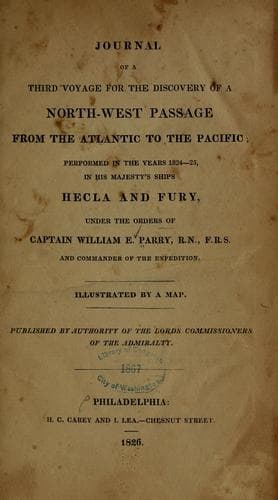
Journal of the Third Voyage for the Discovery of a North-West PassageParry, William Edward, Sir
History
Journal of the Third Voyage for the Discovery of a North-West Passage
Parry, William Edward, Sir
Arctic regions -- Discovery and exploration -- British; Fury (Ship); Hecla (Ship); Northwest Passage
nature of those repairs would in all probability involve the
disagreeable, I may say the ruinous, necessity of heaving the ship down.
After rowing about three-quarters of a mile we considered ourselves
fortunate in arriving at a bolder part of the beach, where three grounded
masses of ice, having from three to four fathoms water at low tide within
them, were so disposed as to afford, with the assistance of art,
something like shelter. Wild and insecure as, under other circumstances,
such a place would have been thought for the purpose of heaving a ship
down, we had no alternative, and therefore as little occasion as we had
time for deliberation. Returning to the ships, we were setting the sails
in order to run to the appointed place, when the ice closed in and
prevented our moving, and in a short time there was once more no open
water to be seen. We were, therefore, under the necessity of remaining
in our present berths, where the smallest external pressure must
inevitably force us ashore, neither ship having more than two feet of
water to spare. One watch of the _Hecla’s_ crew were sent round to
assist at the _Fury’s_ pumps, which required one-third of her ship’s
company to be constantly employed at them.
The ice coming in with considerable violence on the night of the 2nd,
once more forced the _Fury_ on shore, so that at low water she sewed two
feet and a half. Nothing but the number and strength of the _Hecla’s_
hawsers prevented her sharing the same fate, for the pressure was just as
much as seven of these of six inches and two stream-cables would bear.
The _Fury_ floated in the morning, and was enabled to haul off a little,
but there was no opening of the ice to allow us to move to our intended
station. The more leisure we obtained to consider the state of the
_Fury_, the more apparent became the absolute, however unfortunate,
necessity of heaving her down. Four pumps were required to be at work
without intermission to keep her free, and this in perfectly smooth
water, showing that she was, in fact, so materially injured as to be very
far from seaworthy. One-third of her working men were constantly
employed, as before remarked, in this laborious operation, and some of
their hands had become so sore from the constant friction of the ropes,
that they could hardly handle them any longer without the use of mittens,
assisted by the unlaying of the ropes to make them soft. When, in
addition to these circumstances, the wet state of the decks and the
little room left, as well as the reduced strength for working the ship or
heaving at hawsers among the ice, be considered, I believe that every
seaman will admit the impracticability of pursuing this critical
navigation till the _Fury_ had been examined and repaired. As,
therefore, not a moment could be lost we took advantage of a small lane
of water deep enough for boats, which kept open within the grounded
masses along the shore, to convey to the _Hecla_ some of the _Fury’s_ dry
Public-domain text, read in full here on John Shaqi.
Reviews
Reviews
No reviews yet
Be the first to share your thoughts on this work.
Join the Discussion
Join the discussion
Sign in to leave a comment or review.
Sign InorCreate an account