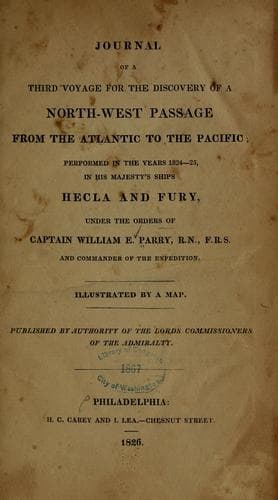
Journal of the Third Voyage for the Discovery of a North-West PassageParry, William Edward, Sir
History
Journal of the Third Voyage for the Discovery of a North-West Passage
Parry, William Edward, Sir
Arctic regions -- Discovery and exploration -- British; Fury (Ship); Hecla (Ship); Northwest Passage
The ice still continuing very close on the 9th, all hands were employed
in attempting, by saws and axes, to clear the _Hecla_, which still
grounded on the tongue of ice every tide. After four hours’ labour, they
succeeded in making four or five feet of room astern, when the ship
suddenly slid down off the tongue with considerable force, and became
once more afloat. We then got on shore the _Hecla’s_ cables and hawsers
for the accommodation of the _Fury’s_ men in our tiers during the heaving
down, struck our top-masts which would be required as shores and
outriggers, and, in short, continued to occupy every individual in some
preparation or other. These being entirely completed at an early hour in
the afternoon, we ventured to go on with the landing of the coals and
provisions from the _Fury_, preferring to run the risk which would thus
be incurred, to the loss of even a few hours in the accomplishment of our
present object. As it very opportunely happened, however, the external
ice slackened to the distance of about a hundred yards outside of us on
the morning of the 10th, enabling us, by a most tedious and laborious
operation, to clear the ice out of our basin piece by piece. The
difficulty of this apparently simple process consisted in the heavy
pressure having repeatedly doubled one mass under another—a position in
which it requires great power to move them—and also by the corners
locking in with the sides of the bergs. Our next business was to tighten
the cables sufficiently by means of purchases, and to finish the floating
of them in the manner and for the purpose before described. After this
had been completed, the ships had only a few feet in length, and nothing
in breadth to spare; but we had now great hopes of going on with our work
with increased confidence and security. The _Fury_, which was placed
inside, had something less than eighteen feet at low water; the _Hecla_
lay in four fathoms, the bottom being strewed with large and small
fragments of limestone.
While thus employed in securing the ships, the smoothness of the water
enabled us to see in some degree the nature of the _Fury’s_ damage; and
it may be conceived how much pain it occasioned us plainly to discover
that both the stern-post and forefoot were broken and turned up on one
side with the pressure. We also could perceive as far as we were able to
see along the main-keel, that it was much torn, and we had therefore
reason to conclude that the damage would altogether prove very serious.
We also discovered that several feet of the _Hecla’s_ false keel were
torn away abreast of the fore-chains, in consequence of her grounding
forward so frequently.
Public-domain text, read in full here on John Shaqi.
Reviews
Reviews
No reviews yet
Be the first to share your thoughts on this work.
Join the Discussion
Join the discussion
Sign in to leave a comment or review.
Sign InorCreate an account