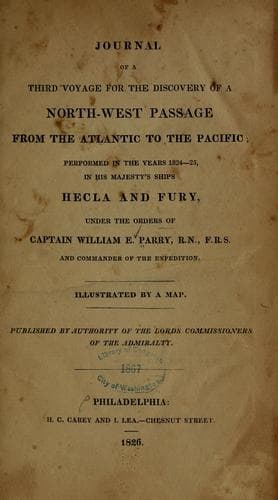
Journal of the Third Voyage for the Discovery of a North-West PassageParry, William Edward, Sir
History
Journal of the Third Voyage for the Discovery of a North-West Passage
Parry, William Edward, Sir
Arctic regions -- Discovery and exploration -- British; Fury (Ship); Hecla (Ship); Northwest Passage
From this trial of the efficacy of our means of security, it was plain
that the _Fury_ could not possibly be hove down under circumstances of
such frequent and imminent risk; I therefore directed a fourth anchor,
with two additional cables, to be carried out, with the hope of breaking
some of the force of the ice by its offering a more oblique resistance
than the other, and thus by degrees turning the direction of the pressure
from the ships. We had scarcely completed this new defence, when the
largest floe we had seen since leaving Port Bowen came sweeping along the
shore, having a motion to the southward of not less than a mile and a
half an hour; and a projecting point of it just grazing our outer berg,
threatened to overturn it, and would certainly have dislodged it from its
situation but for the cable recently attached to it. A second similar
occurrence took place with a smaller mass of ice about midnight, and near
the top of an unusually high spring tide, which seemed ready to float
away every security from us. For three hours about the time of this high
water, our situation was a most critical one, for had the bergs, or
indeed any one of them, been carried away or broken, both ships must
inevitably have been driven on shore by the very next mass of ice that
should come in. Happily, however, they did not suffer any further
material disturbance, and the main body keeping at a short distance from
the land until the tide had fallen, the bergs seemed to be once more
firmly resting on the ground. The only mischief, therefore, occasioned
by this disturbance was the slackening of our cables by the alteration in
the positions of the several grounded masses, and the consequent
necessity of employing more time, which nothing but absolute necessity
could induce us to bestow in adjusting and tightening the whole of them
afresh.
The wind veering to the W.N.W. on the morning of the 15th, and still
continuing to blow strong, the ice was forced three or four miles off the
land in the course of a few hours, leaving us a quiet day for continuing
our work, but exciting no very pleasing sensations when we considered
what progress we might have been making had we been at liberty to pursue
our object. The land was, indeed, so clear of ice to the southward that
Dr. Neill, who walked a considerable distance in that direction, could
see nothing but an open channel in-shore to the utmost extent of his
view. We took advantage of this open water to send the launch for the
_Fury’s_ ironwork left at the former station; for though the few men thus
employed could very ill be spared, we were obliged to arrange everything
with reference to the ultimate saving of time; and it would have occupied
both ships’ companies more than a whole day to carry the things round by
land.
Public-domain text, read in full here on John Shaqi.
Reviews
Reviews
No reviews yet
Be the first to share your thoughts on this work.
Join the Discussion
Join the discussion
Sign in to leave a comment or review.
Sign InorCreate an account