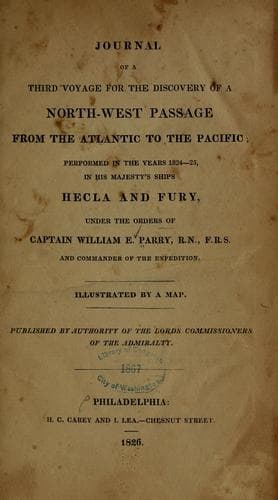
Journal of the Third Voyage for the Discovery of a North-West PassageParry, William Edward, Sir
History
Journal of the Third Voyage for the Discovery of a North-West Passage
Parry, William Edward, Sir
Arctic regions -- Discovery and exploration -- British; Fury (Ship); Hecla (Ship); Northwest Passage
In running down Davis’s Strait, as well as in crossing the Atlantic, we
saw on this passage as well as in all our former autumnal ones, a good
deal of the Aurora Borealis. It first began to display itself on the
15th of September, about the latitude of 69½°, appearing in the (true)
south-east quarter as a bright luminous patch five or six degrees above
the horizon, almost stationary for two or three hours together, but
frequently altering its intensity, and occasionally sending up vivid
streamers towards the zenith. It appeared in the same manner on several
subsequent nights in the south-west, west, and east quarters of the
heavens; and on the 20th a bright arch of it passed across the zenith
from S.E. to N.W., appearing to be very close to the ship, and affording
so strong a light as to throw the shadow of objects on the deck. The
next brilliant display, however, of this beautiful phenomenon which we
now witnessed, and which far surpassed anything of the kind observed at
Port Bowen, occurred on the night of the 24th of September, in latitude
58½°, longitude 44½°. It first appeared in a (true) east direction, in
detached masses like luminous clouds of yellow or sulphur-coloured light,
about three degrees above the horizon. When this appearance had
continued for about an hour, it began at nine P.M. to spread upwards, and
gradually extended itself into a narrow band of light passing through the
zenith and again downwards to the western horizon. Soon after this the
streams of light seemed no longer to emanate from the eastward, but from
a fixed point about one degree above the horizon on a true west bearing.
From this point, as from the narrow point of a funnel, streams of light,
resembling brightly illuminated vapour or smoke, appeared to be
incessantly issuing, increasing in breadth as they proceeded, and darting
with inconceivable velocity, such as the eye could scarcely keep pace
with, upwards towards the zenith, and in the same easterly direction
which the former arch had taken. The sky immediately under the spot from
which the light issued appeared, by a deception very common in this
phenomenon, to be covered with a dark cloud, whose outline the
imagination might at times convert into that of the summit of a mountain,
from which the light proceeded like the flames of a volcano. The streams
of light as they were projected upwards did not consist of continuous
vertical columns or streamers, but almost entirely of separate, though
constantly renewed masses, which seemed to roll themselves laterally
onward with a sort of undulating motion, constituting what I have
understood to be meant by that modification of the Aurora called the
“merry dancers,” which is seen in beautiful perfection at the Shetland
Islands. The general colour of the light was yellow, but an orange and a
greenish tinge were at times very distinctly perceptible, the intensity
of the light and colours being always the greatest when occupying the
smallest space.
Public-domain text, read in full here on John Shaqi.
Reviews
Reviews
No reviews yet
Be the first to share your thoughts on this work.
Elsewhere in the archive
Join the Discussion
Join the discussion
Sign in to leave a comment or review.
Sign InorCreate an account