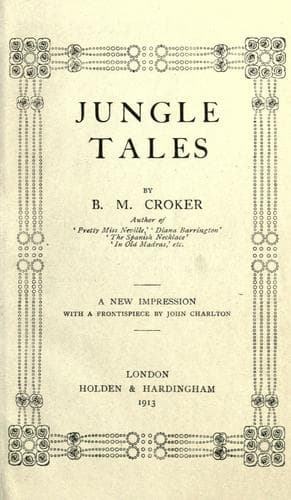
British -- India -- Fiction; India -- History -- British occupation, 1765-1947 -- Fiction; Short stories
Then Durga Pershad covered his face, and lo! as he turned to the wall,
he died.
TWO LITTLE TRAVELLERS.
CHAPTER I.
Gram had fallen to nine seers for the rupee, which affected the
sahibs who kept horses and polo ponies; and rice was down to eight
measures--this affected the villagers and ryots. The rains due at
Christmas had failed. There was talk of a great scarcity and a sore
famine in the land, especially among the sleek, crafty bunnias, who
bought up every ounce of grain in the district when it was cheap,
and at the first whisper of failing crops--often a rumour started by
themselves--locked it up relentlessly, in hopes of starvation prices,
refusing to sell save at exorbitant rates.
What is a road coolie to do under these conditions?--a man whose daily
wage never exceeds one anna and a half, no matter how markets may
fluctuate. Three rupees’ worth of grain will keep him alive for twenty
days; but how is he to exist for the remainder of the month? How is he
to feed his children, to pay his tiny rental, and the village tax?
This was a problem that Chūnnee pondered over, as he sat on a heap of
stones at the side of the road, with his empty basket at his feet,
and a look of despair upon his handsome, and usually good-humoured,
countenance.
Alas! Chūnnee had been born under an evil star. Scorpio was his
constellation, and all the luck had ebbed from him, as surely as it had
flowed towards his half-brother Zālim Sing.
Now, Zālim Sing was prosperous and well-to-do, the proprietor of a good
mud house, a patch of castor oil, and two biggahs of land, planted
in rape and linseed; he also owned a huge milch buffalo, a pair of
plough bullocks, and the only ekka within three koss. Yes, an ekka that
came to him with his wife, all lavishly decorated with brass knobs and
ornamental work, an ekka that had yellow curtains, and was drawn by
a bay tat (a bazaar pony), with six rows of blue beads round her ewe
neck. Zālim Sing was prouder of his turn-out than any parvenu’s wife
with her first equipage; and perhaps it was on the strength of this,
more than his store of linseed and his plot of land, that the village
elders hearkened to him with respect. He was a lean, shrewd-looking
man, with a cast in his eye and a halt in his gait. Nevertheless, he
had prospered, and the world had gone well with him, whereas it had
gone ill with his half-brother.
But Chūnnee was not wise in his generation; he had bartered away his
share of the ancestral home for two cows, a grindstone, and some brass
cooking-pots. The cows had died the rains before last, the cooking-pots
were pawned to the local soucar; his crop of one mango tree had
failed, he had no capital except his sturdy frame, two horny hands, and
his coolie basket.
Public-domain text, read in full here on John Shaqi.
Reviews
Reviews
No reviews yet
Be the first to share your thoughts on this work.
Join the Discussion
Join the discussion
Sign in to leave a comment or review.
Sign InorCreate an account