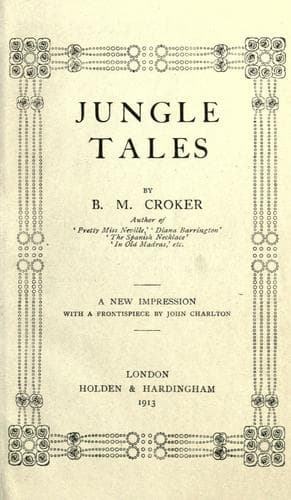
British -- India -- Fiction; India -- History -- British occupation, 1765-1947 -- Fiction; Short stories
In his hovel there were his children--Girunda, a boy aged ten, and
Gyannia, a girl of four. There was also a mat, an old charpoy, a
reaping-hook, a couple of earthen pots, and a white cat. This was all
that Chūnnee possessed in the wide world. It might have sufficed, had
he had wisdom like his brother; but, alas! he had no brains. There he
sat, on the kunker heap, that glaring February afternoon. The land was
still covered with cane crops; the barley was green, and in the ear;
dry leaves were whirling along the road; the banka tree was dropping
red flowers from its grey, leafless branches; the mango tree was in
blossom. Yes, the hot weather, the time of parching and scarcity, would
be on them soon. Suddenly he heard a rattling, and felt a cloud of
warm yellow dust. It was his brother’s ekka. Zālim Sing and a friend
tore past at a gallop, and scarcely noticed the coolie on the side of
the road, beyond a hoarse laugh of derision. Why had fortune been kind
to one brother and cruel to another? Why had his cows died?--his wife
been bitten by a “karite” as she cut vetches, and expired at sundown in
agonies? Ah, Junia was a loss--nigh as great as the cows. She cooked,
and minded the children; she earned one anna a day for reaping; she was
fortunate to die young; she had never lived to know hunger. Why had
some people stores and treasures, to whom they were of no use, whilst
others lacked a morsel to keep them from perishing?
Chūnnee sat for half an hour with his arms loosely folded on his
breast, and pondered this question in his heart. Presently he arose,
and picked up his basket, and took the path towards his village, where
its brown mud walls and straw roofs stood out in strong relief against
a noble tope of mango trees; but these mangoes were the property of the
sirkar (government). Many an envious eye had been cast on them and
their fine yearly harvests. Despite bazaar rumours about scarcity, it
was surely what is called a bunnia’s famine; for this hungry, handsome
Rajpoot, with the form and sinews of some Greek god, made his way
homewards between marvellous crops at either side of the well-beaten
path. The self-same rich land was yielding gram, rape, linseed; whilst
barley towered high above all. Where else will the earth yield four
harvests with little manure or care? But not an inch of this fertile
soil called Chūnnee master! And what to him was all this fertility?
As he strode along, a fierce temptation kept pace with his steps, and
whispered eagerly in his ear--
Public-domain text, read in full here on John Shaqi.
Reviews
Reviews
No reviews yet
Be the first to share your thoughts on this work.
Elsewhere in the archive
Join the Discussion
Join the discussion
Sign in to leave a comment or review.
Sign InorCreate an account