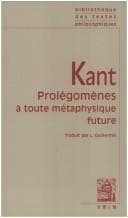
Kant's Prolegomena to Any Future MetaphysicsKant, Immanuel
PhilosophyPhilosophy
Kant's Prolegomena to Any Future Metaphysics
Kant, Immanuel
Knowledge, Theory of -- Early works to 1800; Metaphysics -- Early works to 1800
Metaphysics has hitherto never been able to prove a priori either this
proposition, or that of sufficient reason, still, less any more
complex theorem, such as belongs to psychology or cosmology, or indeed
any synthetical proposition. By all its analysing therefore nothing is
affected, nothing obtained or forwarded, and the science, after all
this bustle and noise, still remains as it was in the days of
Aristotle, though far better preparations were made for it than of
old, if the clue to synthetical cognitions had only been discovered.
If any one thinks himself offended, he is at liberty to refute my
charge by producing a single synthetical proposition belonging to
metaphysics, which he would prove dogmatically a priori, for until he
has actually performed this feat, I shall not grant that he has truly
advanced the science; even should this proposition be sufficiently
confirmed by common experience. No demand can be more moderate or more
equitable, and in the (inevitably certain) event of its
non-performance, no assertion more just, than that hitherto
metaphysics has never existed as a science.
But there are two things which, in case the challenge be accepted, I
must deprecate: first, trifling about probability and conjecture,
which are suited as little to metaphysics, as to geometry; and
secondly, a decision by means of the magic wand of common sense, which
does not convince every one, but which accommodates itself to personal
peculiarities.
For as to the former, nothing can be more absurd, than in metaphysics,
a philosophy from pure reason to think of grounding our judgments upon
probability and conjecture. Everything that is to be cognised a
priori, is thereby announced as apodeictically certain, and must
therefore be proved in this way. We might as well think of grounding
geometry or arithmetic upon conjectures. As to the doctrine of chances
in the latter, it does not contain probable, but perfectly certain,
judgments concerning the degree of the probability of certain cases,
under given uniform conditions, which, in the sum of all possible
cases, infallibly happen according to the rule, though it is not
sufficiently determined in respect to every single chance. Conjectures
(by means of induction and of analogy) can be suffered in an empirical
science of nature only, yet even there the possibility at least of
what we assume must be quite certain.
Public-domain text, read in full here on John Shaqi.
Reviews
Reviews
No reviews yet
Be the first to share your thoughts on this work.
Elsewhere in the archive
Join the Discussion
Join the discussion
Sign in to leave a comment or review.
Sign InorCreate an account