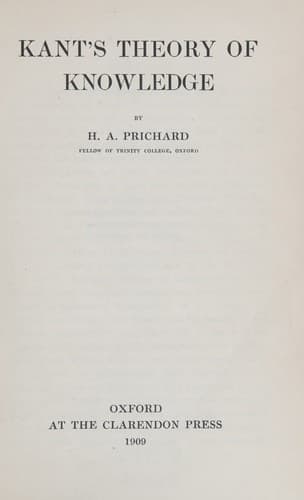
Kant's Theory of KnowledgePrichard, H. A. (Harold Arthur)
Philosophy
Kant's Theory of Knowledge
Prichard, H. A. (Harold Arthur)
Kant, Immanuel, 1724-1804; Knowledge, Theory of
not as his problem requires that it should be treated, i. e. as a
representation of something, but as something represented,[45] i. e.
as something of which we are aware, viz. a part or a quality of an
object. In the _fourth_ place, not only is that which Kant speaks of
as related to an object really not a representation, but also--as we
see if we consider the fact which Kant has in mind--that to which he
speaks of it as related is really not _an_ object but _one and the
same object to which another so-called representation is related_. For
what Kant says is that representations as related to an object must
agree among themselves. But this statement, to be significant, implies
that the object to which various representations are related is _one
and the same_. Otherwise why should the representations agree? In
view, therefore, of these last two considerations we must admit that
the real thought underlying Kant's statement should be expressed thus:
'We find that the thought that _two or more parts or qualities of an
object_ relate to _one and the same object_ carries with it a certain
necessity, since this object is considered to be that which _prevents
these parts or qualities which we know it to possess_ from being
determined at random, because by being related to _one and the same
object_, they must agree among themselves.' The importance of the
correction lies in the fact that what Kant is stating is not what he
thinks he is stating. He is really stating the implication of the
thought that two or more qualities or parts of some object or other,
which, as such, already relate to an object, relate to one and the
same object. He thinks he is stating the implication of the thought
that a representation which in itself has no relation to an object,
has relation to an object. And since his problem is simply to
determine what constitutes the relatedness to an object of that which
in itself is a mere representation, the distinction is important; for
it shows that he really elucidates it by an implication respecting
something which already has relation to an object and is not a mental
modification at all, but a quality or a part of an object.
[43] Cf. pp. 230-3.
[44] _Erkenntnisse._
[45] _Vorgestellt._
Public-domain text, read in full here on John Shaqi.
Reviews
Reviews
No reviews yet
Be the first to share your thoughts on this work.
Elsewhere in the archive
Join the Discussion
Join the discussion
Sign in to leave a comment or review.
Sign InorCreate an account