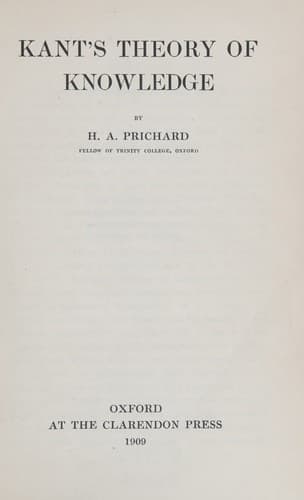
Kant's Theory of KnowledgePrichard, H. A. (Harold Arthur)
Philosophy
Kant's Theory of Knowledge
Prichard, H. A. (Harold Arthur)
Kant, Immanuel, 1724-1804; Knowledge, Theory of
In the first place, it is clear that the general nature of the terms
must correspond with or be adapted to the general nature of the
relationship to be effected. Thus if two terms are to be related as
more or less loud, they must be sounds, since the relation in question
is one in respect of sound and not, e. g., of time or colour or space.
Similarly, terms to be related as right and left must be bodies in
space, right and left being a spatial relation. Again, only human
beings can be related as parent and child. Kant's doctrine, however,
does not conform to this presupposition. For the manifold to be
related consists solely of sensations, and of individual spaces, and
perhaps individual times, as elements of pure perception; and such a
manifold is not of the kind required. Possibly individual spaces may
be regarded as adequate terms to be related or combined into
geometrical figures, e. g. into lines or triangles. But a house as a
synthesis of a manifold cannot be a synthesis of spaces, or of times,
or of sensations. Its parts are bodies, which, whatever they may be,
are neither sensations nor spaces nor times, nor combinations of them.
In reality they are substances of a special kind. Again, the relation
of cause and effect is not a relation of sensations or spaces or
times, but of successive states of physical things or substances, the
relation consisting in the necessity of their succession.
In the second place, it is clear that the special nature of the
relation to be effected presupposes a special nature on the part of
the terms to be related. If one sound is to be related to another by
way of the octave, that other must be its octave. If one quantity is
to be related to another as the double of it, that quantity must be
twice as large as the other. In the same way, proceeding to Kant's
instances, we see that if we are to combine or relate a manifold into
a triangle, and therefore into a triangle of a particular size and
shape, the elements of the manifold must be lines, and lines of a
particular size. If we are to combine a manifold into a house, and
therefore into a house of a certain shape and size, the manifold must
consist of bodies of a suitable shape and size. If we are to relate a
manifold by way of necessary succession, the manifold must be such
that it can be so related; in other words, if we are to relate an
element X of the manifold with some other Y as the necessary
antecedent of X, there must be some definite element Y which is
connected with, and always occurs along with, X. To put the matter
generally, we may say that the manifold must be adapted to or 'fit'
the categories not only, as has been pointed out, in the sense that it
must be of the right kind, but also in the sense that its individual
elements must have that orderly character which enables them to be
related according to the categories.
Public-domain text, read in full here on John Shaqi.
Reviews
Reviews
No reviews yet
Be the first to share your thoughts on this work.
Elsewhere in the archive
Join the Discussion
Join the discussion
Sign in to leave a comment or review.
Sign InorCreate an account