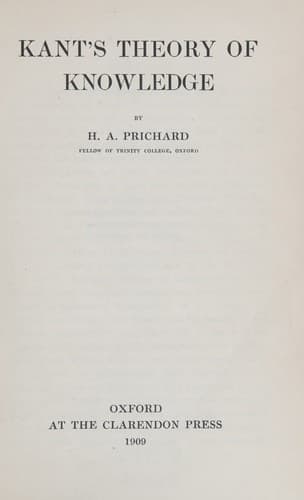
Kant's Theory of KnowledgePrichard, H. A. (Harold Arthur)
Philosophy
Kant's Theory of Knowledge
Prichard, H. A. (Harold Arthur)
Kant, Immanuel, 1724-1804; Knowledge, Theory of
latter it indicates a relation of the manifold _to us_, as being
apprehended by us as the parts of the object. But two relations which,
though they are of one and the same thing, are nevertheless relations
of it to two different things, should not be referred to by the same
phrase. Moreover, since the relatedness is referred to as relatedness
to an object, the phrase properly indicates the relation of the
manifold to an object, and not to us as apprehending it. Again, in the
second place, Kant cannot successfully maintain that the phrase is
primarily a loose expression for our consciousness of the manifold as
related to an object, and that since this implies a process of
synthesis, the phrase may fairly include in its meaning the thought of
the combination of the manifold by us into a whole. For although Kant
asserts--and with some plausibility--that we can only apprehend as
combined what we have ourselves combined, yet when we consider this
assertion seriously we see it to be in no sense true.
[34] A. 109, Mah. 202.
[35] B. 130, M. 80.
[36] To say that 'combining', in the sense of making,
_really_ presupposes consciousness of the nature of the whole
produced, would be inconsistent with the previous assertion
that even where the reality known is something made, the
knowledge of it presupposes that the reality is already made.
Strictly speaking, the activity of combining presupposes
consciousness not of the whole which we _succeed_ in
producing, but of the whole which we _want_ to produce.
It may be noted that, from the point of view of the above
argument, the activity of combining presupposes actual
consciousness of the act of combination and of its principle,
and does not imply merely the possibility of it. Kant, of
course, does not hold this.
The general conclusion, therefore, to be drawn is that the process of
synthesis by which the manifold is said to become related to an object
is a process not of knowledge but of construction in the literal
sense, and that it leaves knowledge of the thing constructed still to
be effected. But if knowing is obviously different from making, why
should Kant have apparently felt no difficulty in resolving knowing
into making? Three reasons may be given.
In the first place, the very question, 'What does the process of
knowing consist in?' at least suggests that knowing can be resolved
into and stated in terms of something else. In this respect it
resembles the modern phrase '_theory_ of knowledge'. Moreover, since
it is plain that in knowing we are active, the question is apt to
assume the form, 'What do we _do_ when we know or think?' and since
one of the commonest forms of doing something is to perform a physical
operation on physical things, whereby we effect a recombination of
them on some plan, it is natural to try to resolve knowing into this
kind of doing, i. e. into making in a wide sense of the word.
Public-domain text, read in full here on John Shaqi.
Reviews
Reviews
No reviews yet
Be the first to share your thoughts on this work.
Elsewhere in the archive
Join the Discussion
Join the discussion
Sign in to leave a comment or review.
Sign InorCreate an account