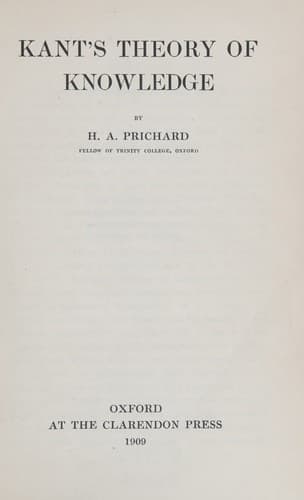
Kant's Theory of KnowledgePrichard, H. A. (Harold Arthur)
Philosophy
Kant's Theory of Knowledge
Prichard, H. A. (Harold Arthur)
Kant, Immanuel, 1724-1804; Knowledge, Theory of
The beginning of Kant's account of schematism may be summarized thus:
'Whenever we subsume an individual object of a certain kind, e. g.
a plate, under a conception, e. g. a circle, the object and the
conception must be homogeneous, that is to say, the individual must
possess the characteristic which constitutes the conception, or, in
other words, must be an instance of it. Pure conceptions, however, and
empirical perceptions, i. e. objects of empirical perception, are
quite heterogeneous. We do not, for instance, perceive cases of cause
and effect. Hence the problem arises, 'How is it possible to subsume
objects of empirical perception under pure conceptions?' The
possibility of this subsumption presupposes a _tertium quid_, which is
homogeneous both with the object of empirical perception and with the
conception, and so makes the subsumption mediately possible. This
_tertium quid_ must be, on the one side, intellectual and, on the
other side, sensuous. It is to be found in a 'transcendental
determination of time', i. e. a conception involving time and involved
in experience. For in the first place this is on the one side
intellectual and on the other sensuous, and in the second place it
is so far homogeneous with the category which constitutes its unity
that it is universal and rests on an _a priori_ rule, and so far
homogeneous with the phenomenon that all phenomena are in time[5].
Such transcendental determinations of time are the schemata of the
pure conceptions of the understanding.' Kant continues as follows:
[5] It may be noted that the argument here really fails. For
though phenomena as involving temporal relations, might
possibly be said to be instances of a transcendental
determination of time, the fact that the latter agrees with
the corresponding category by being universal and _a priori_
does not constitute it homogeneous with the category, in the
sense required for subsumption, viz. that it is an instance
of or a species of the category.
"The schema is in itself always a mere product of the imagination.
But since the synthesis of the imagination has for its aim no single
perception, but merely unity in the determination of the sensibility,
the schema should be distinguished from the image. Thus, if I place
five points one after another, . . . . . this is an image of the
number five. On the other hand, if I only just think a number in
general--no matter what it may be, five or a hundred--this thinking
is rather the representation of a method of representing in an image
a group (e. g. a thousand), in conformity with a certain conception,
than the image itself, an image which, in the instance given, I should
find difficulty in surveying and comparing with the conception. Now
this representation of a general procedure of the imagination to
supply its image to a conception, I call the schema of this
conception."
Public-domain text, read in full here on John Shaqi.
Reviews
Reviews
No reviews yet
Be the first to share your thoughts on this work.
Elsewhere in the archive
Join the Discussion
Join the discussion
Sign in to leave a comment or review.
Sign InorCreate an account