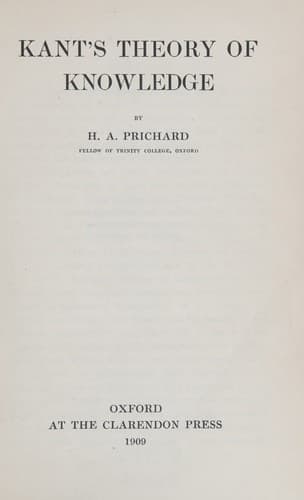
Kant's Theory of KnowledgePrichard, H. A. (Harold Arthur)
Philosophy
Kant's Theory of Knowledge
Prichard, H. A. (Harold Arthur)
Kant, Immanuel, 1724-1804; Knowledge, Theory of
[10] It may be objected that, from Kant's point of view, the
thought of a rule of construction, and the thought of the
principle of the whole to be constructed, are the same thing
from different points of view. But if this be insisted on,
the schema and its corresponding conception become the same
thing regarded from different points of view; consequently
the schema will not be a more concrete conception of an
object than the corresponding conception, but it will be the
conception itself.
If, therefore, Kant succeeds in finding schemata of the categories in
detail in the sense in which they are required for the solution of his
problem, i. e. in the sense of more concrete conceptions involving the
thought of time and relating to objects, we should expect either that
he ignores his general account of a schema, or that if he appeals to
it, the appeal is irrelevant. This we find to be the case. His account
of the first two transcendental schemata makes a wholly irrelevant
appeal to the temporal process of synthesis on our part, while his
account of the remaining schemata makes no attempt to appeal to it at
all.
"The pure _schema_ of _quantity_, as a conception of the
understanding, is _number_, a representation which comprises the
successive addition of one to one (homogeneous elements). Accordingly,
number is nothing else than the unity of the synthesis of the manifold
of a homogeneous perception in general, in that I generate time itself
in the apprehension of the perception."[11]
[11] B. 182, M. 110.
Public-domain text, read in full here on John Shaqi.
Reviews
Reviews
No reviews yet
Be the first to share your thoughts on this work.
Elsewhere in the archive
Join the Discussion
Join the discussion
Sign in to leave a comment or review.
Sign InorCreate an account