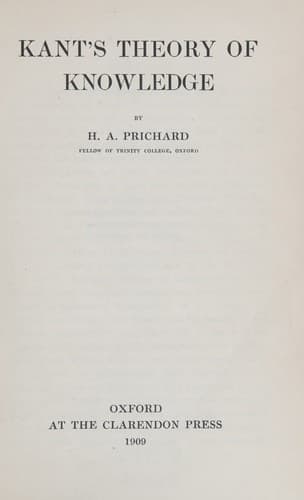
Kant's Theory of KnowledgePrichard, H. A. (Harold Arthur)
Philosophy
Kant's Theory of Knowledge
Prichard, H. A. (Harold Arthur)
Kant, Immanuel, 1724-1804; Knowledge, Theory of
[12] The drift of the passage would seem to be this: 'If we
are to present to ourselves an instance of a quantity, we
must successively combine similar units until they form a
quantity. This process involves the thought of a successive
process by which we add units according to the conception of
a quantity. This thought is the thought of number, and since
by it we present to ourselves an instance of a quantity, it
is the schema of quantity.' But if this be its drift,
considerations of sense demand that it should be rewritten,
at least to the following extent: 'If we are to present to
ourselves an instance of a _particular_ quantity [which will
really be a particular number, for it must be regarded as
discrete, (cf. B. 212, M. 128 fin., 129 init.)] e. g. three,
we must successively combine units until they form _that_
quantity. This process involves the thought of a successive
process, by which we add units according to the conception of
_that_ quantity. This thought is the thought of a particular
number, and since by it we present to ourselves an instance
of _that_ quantity, this thought is the schema of _that_
quantity.' If this rewriting be admitted to be necessary, it
must be allowed that Kant has confused (_a_) the thoughts of
particular quantities and of particular numbers with those of
quantity and of number in general respectively, (_b_) the
thought of a particular quantity with that of a particular
number (for the process referred to presupposes that the
particular quantity taken is known to consist of a number of
equal units) and (_c_) the thought of counting with that of
number.
[13] This statement is, of course, not meant as a definition
of counting, but as a means of bringing out the distinction
between a process of counting and a number.
[14] For the thought of a number is the thought of a quantity
of a special kind, viz. of a quantity made up of a number of
similar units without remainder.
Public-domain text, read in full here on John Shaqi.
Reviews
Reviews
No reviews yet
Be the first to share your thoughts on this work.
Elsewhere in the archive
Join the Discussion
Join the discussion
Sign in to leave a comment or review.
Sign InorCreate an account