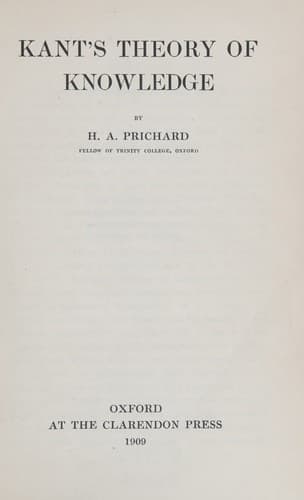
Kant's Theory of KnowledgePrichard, H. A. (Harold Arthur)
Philosophy
Kant's Theory of Knowledge
Prichard, H. A. (Harold Arthur)
Kant, Immanuel, 1724-1804; Knowledge, Theory of
imagination, to supply this deficiency, and raise up to himself the
idea of that particular shade, tho' it had never been conveyed to him
by his senses? I believe there are few but will be of opinion that he
can; and this may serve as a proof, that the simple ideas are not
always derived from the correspondent impressions; tho' the instance
is so particular and singular, that 'tis scarce worth our observing,
and does not merit that for it alone we should alter our general
maxim."[14]
[14] Hume, _Treatise_, Bk. I, Part 1, § 1.
CHAPTER XII
THE ANALOGIES OF EXPERIENCE
Each of the three categories of relation, i. e. those of substance and
accident, of cause and effect, and of interaction between agent and
patient involves, according to Kant, a special principle, and these
special principles he calls 'analogies of experience'. They are stated
thus:[1] (1) In all changes of phenomena the substance is permanent,
and its quantity in nature is neither increased nor diminished. (2)
All changes take place according to the law of the connexion of cause
and effect. (3) All substances, so far as they can be perceived in
space as coexistent, are in complete interaction. The justification of
the term _analogy_ of experience is as follows. In mathematics an
analogy is a formula which asserts the equality of two _quantitative_
relations, and is such that, if three of the terms are given, we can
discover the fourth, e. g. if we know that _a_ : _b_ = _c_ : _d_, and
that _a_ = 2, _b_ = 4, _c_ = 6 we can discover that _d_ = 12. But in
philosophy an analogy is the assertion of the equality of two
_qualitative_ relations and is such that, if three of the terms are
given, we can discover, not the fourth, but only the relation of the
third to the fourth, though at the same time we are furnished with a
clue whereby to search for the fourth in experience. In this
philosophical sense, the principles involved in the categories of
relation are analogies. For instance, the principles of causality can
be stated in the form 'Any known event _X_ is to _some other_ event
_Y_, whatever it be, as effect to cause'; so stated, it clearly
informs us not of the character of _Y_ but only of the fact that there
must be a _Y_, i. e. a necessary antecedent, though at the same time
this knowledge enables us to search in experience for the special
character of _Y_.
[1] The formulation of them in the first edition is slightly
different.
Public-domain text, read in full here on John Shaqi.
Reviews
Reviews
No reviews yet
Be the first to share your thoughts on this work.
Elsewhere in the archive
Join the Discussion
Join the discussion
Sign in to leave a comment or review.
Sign InorCreate an account