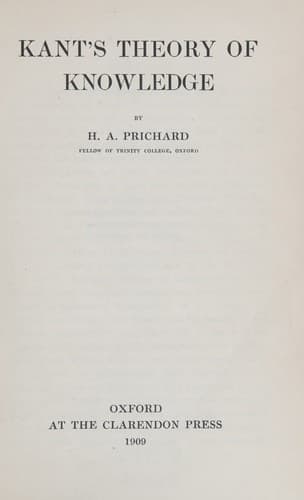
Kant's Theory of KnowledgePrichard, H. A. (Harold Arthur)
Philosophy
Kant's Theory of Knowledge
Prichard, H. A. (Harold Arthur)
Kant, Immanuel, 1724-1804; Knowledge, Theory of
This well-known passage[1] practically replaces a long section,[2]
contained only in the first edition, on the fourth paralogism of
pure reason. Its aim is to vindicate against 'idealism' the reality
of objects in space, and it is for this reason inserted after the
discussion of the second postulate. The interest which it has excited
is due to Kant's use of language which at least seems to imply that
bodies in space are things in themselves, and therefore that here he
really abandons his main thesis.
[1] B. 274-9, M. 167-9. Cf. B. xxxix (note), M. xl (note).
[2] A. 367-80, Mah. 241-53.
Idealism is the general name which Kant gives to any view which
questions or denies the reality of the physical world; and, as has
been pointed out before,[3] he repeatedly tries to defend himself
against the charge of being an idealist in this general sense. This
passage is the expression of his final attempt. Kant begins by
distinguishing two forms which idealism can take according as it
regards the existence of objects in space as false and _impossible_,
or as doubtful and _indemonstrable_. His own view, which regards their
existence as certain and demonstrable, and which he elsewhere[4]
calls transcendental idealism, constitutes a third form. The first
form is the dogmatic idealism of Berkeley. This view, Kant says,
is unavoidable, if space be regarded as a property of things in
themselves, and the basis of it has been destroyed in the _Aesthetic_.
The second form is the problematic idealism of Descartes, according to
which we are immediately aware only of our own existence, and belief
in the existence of bodies in space can be only an inference, and an
uncertain inference, from the immediate apprehension of our own
existence. This view, according to Kant, is the outcome of a
philosophical attitude of mind, in that it demands that a belief
should be proved, and apparently--to judge from what Kant says of
Berkeley--it does not commit Descartes to the view that bodies in
space, if their reality can be vindicated, are things in themselves.
[3] Cf. p. 76.
[4] A. 369, Mah. 243; cf. B. 44, M. 27.
Public-domain text, read in full here on John Shaqi.
Reviews
Reviews
No reviews yet
Be the first to share your thoughts on this work.
Elsewhere in the archive
Join the Discussion
Join the discussion
Sign in to leave a comment or review.
Sign InorCreate an account