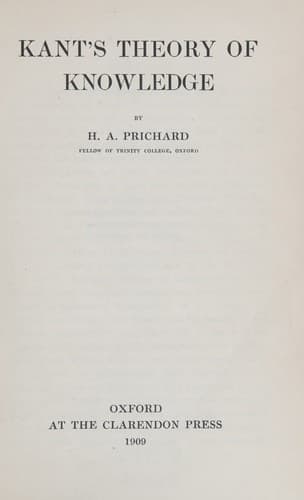
Kant's Theory of KnowledgePrichard, H. A. (Harold Arthur)
Philosophy
Kant's Theory of Knowledge
Prichard, H. A. (Harold Arthur)
Kant, Immanuel, 1724-1804; Knowledge, Theory of
[10] The ambiguity of the phrase 'external to me' is pointed
out in the suppressed account of the fourth paralogism,
where it is expressly declared that objects in space are
only representations. (A. 372-3, Mah. 247). Possibly the
introduction of an argument which turns on the view that they
are not representations may have had something to do with the
suppression.
Nevertheless, the _Refutation_ may be considered to suggest the proper
refutation of Descartes. It is possible to ignore Kant's demand for a
permanent as a condition of the apprehension of our successive states,
and to confine attention to his remark that he has shown that external
experience is really immediate, and that only by means of it is the
consciousness of our existence as determined in time possible.[11] If
we do so, we may consider the _Refutation_ as suggesting the view that
Descartes' position is precisely an inversion of the truth; in other
words, that our consciousness of the world, so far from being an
uncertain inference from the consciousness of our successive states,
is in reality a presupposition of the latter consciousness, in that
this latter consciousness only arises through reflection upon the
former, and that therefore Descartes' admission of the validity of
self-consciousness implicitly involves the admission _a fortiori_ of
the validity of our consciousness of the world.[12]
[11] B. 277, M. 167 fin.
[12] Cf. Caird, i. 632 and ff.
Oxford: Printed at the Clarendon Press by HORACE HART, M.A.
Public-domain text, read in full here on John Shaqi.
Reviews
Reviews
No reviews yet
Be the first to share your thoughts on this work.
Elsewhere in the archive