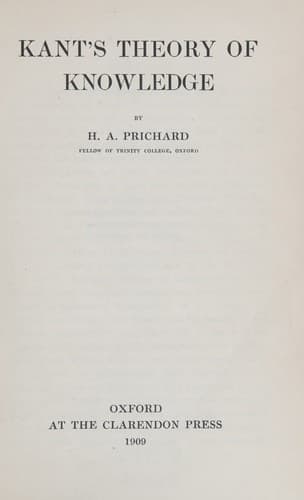
Kant's Theory of KnowledgePrichard, H. A. (Harold Arthur)
Philosophy
Kant's Theory of Knowledge
Prichard, H. A. (Harold Arthur)
Kant, Immanuel, 1724-1804; Knowledge, Theory of
There remains to be answered the question whether Kant's position is
tenable in its other form, viz. that while we cannot say that reality
is spatial, we can and must say that the appearances which it produces
are spatial. This question, in view of the foregoing, can be answered
as soon as it is stated. We must allow that reality is spatial, since,
as has been pointed out, assertions concerning the apparent shape of
things presuppose that they are spatial. We must equally allow that an
appearance cannot be spatial. For on the one hand, as has just been
shown, space and spatial relations can only qualify something the
existence of which is not relative to perception, since it is
impossible to perceive what is spatial as it is; and on the other hand
an appearance, as being _ex hypothesi_ an appearance to some one,
i. e. to a percipient, must be relative to perception.
We may say, then, generally, that analysis of the distinction between
appearance and reality, as it is actually drawn in our ordinary
consciousness, shows the falsity of both forms of the philosophical
agnosticism which appeals to the distinction. We know things; not
appearances. We know what things are; and not merely what they appear
but are not. We may also say that Kant cannot possibly be successful
in meeting, at least in respect of space, what he calls 'the easily
foreseen but worthless objection that the ideality of space and of
time would turn the whole sensible world into pure illusion'.[29] For
space, according to him, is not a property of things in themselves; it
cannot, as has been shown, be a property of appearances; to say that
it is a property of things as they appear to us is self-contradictory;
and there is nothing else of which it can be said to be a property.
[29] _Prol_., § 13, Remark iii. (Cf. p. 100 note.) Cf. the
confused note B. 70, M. 42. (See Dr. Vaihinger's Commentary
on the _Critique_, ii, 488 ff.)
In conclusion, it may be pointed out that the impossibility that
space[30] and spatial characteristics should qualify appearances
renders untenable Kant's attempt to draw a distinction between reality
and appearance _within_ 'phenomena' or 'appearances'. The passage in
which he tries to do so runs as follows:
[30] The case of time can be ignored, since, as will be seen
later (pp. 112-14), the contention that space is 'ideal'
really involves the admission that time is real.
Public-domain text, read in full here on John Shaqi.
Reviews
Reviews
No reviews yet
Be the first to share your thoughts on this work.
Elsewhere in the archive
Join the Discussion
Join the discussion
Sign in to leave a comment or review.
Sign InorCreate an account