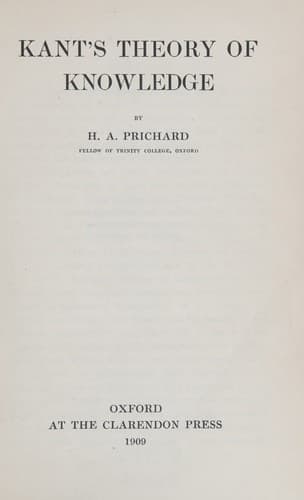
Kant's Theory of KnowledgePrichard, H. A. (Harold Arthur)
Philosophy
Kant's Theory of Knowledge
Prichard, H. A. (Harold Arthur)
Kant, Immanuel, 1724-1804; Knowledge, Theory of
Nevertheless, the tendency to think that the only object or, at least,
the only direct object of the mind is something mental still requires
explanation. It seems due to a tendency to treat self-consciousness as
similar to consciousness of the world. When in reflection we turn our
attention away from the world to the activity by which we come to know
it, we tend to think of our knowledge of the world as a reality to be
apprehended similar to the world which we apprehended prior to
reflection. We thereby implicitly treat this knowledge as something
which, like the world, merely _is_ and is not the knowledge of
anything; in other words, we imply that, so far from being knowledge,
i. e. the knowing of a reality, it is precisely that which we
distinguish from knowledge, viz. a reality to be known,
although--since knowledge must be mental--we imply that it is a
reality of the special kind called mental. But if the knowledge upon
which we reflect is thus treated as consisting in a mental reality
which merely _is_, it is implied that in this knowledge the world is
not, at any rate directly, object of the mind, for _ex hypothesi_ a
reality which merely _is_ and is not the knowledge of anything has no
object. Hence it comes to be thought that the only object or, at
least, the only direct object of the mind is this mental reality
itself, which is the object of reflection; in other words, that the
only immediate object of the mind comes to be thought of as its own
idea. The root of the mistake lies in the initial supposition--which,
it may be noted, seems to underlie the whole treatment of knowledge by
empirical psychology--that knowledge can be treated as a reality to be
apprehended, in the way in which any reality which is not knowledge is
a reality to be apprehended.
We may now revert to that form of idealism which maintains that the
essential relation of reality to the mind is that of _being known_,
in order to consider two lines of argument by which it may be
defended.
According to the first of these, the view of the plain man either is,
or at least involves, materialism; and materialism is demonstrably
absurd. The plain man's view involves the existence of the physical
world prior to the existence of the knowledge of it, and therefore
also prior to the existence of minds which know it, since it is
impossible to separate the existence of a knowing mind from its actual
knowledge. From this it follows that mere matter, having only the
qualities considered by the physicist, must somehow have originated or
produced knowing and knowing minds. But this production is plainly
impossible. For matter, possessing solely, as it does, characteristics
bound up with extension and motion, cannot possibly have originated
activities of a wholly different kind, or beings capable of exercising
them.
Public-domain text, read in full here on John Shaqi.
Reviews
Reviews
No reviews yet
Be the first to share your thoughts on this work.
Elsewhere in the archive
Join the Discussion
Join the discussion
Sign in to leave a comment or review.
Sign InorCreate an account