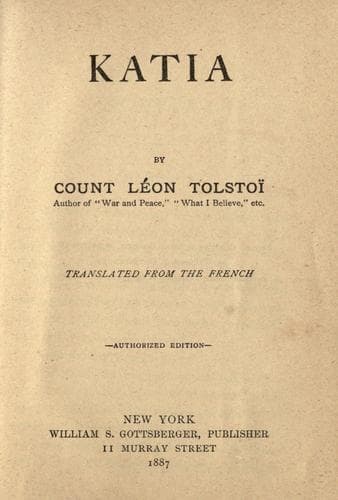
Man-woman relationships -- Fiction; Marriage -- Fiction; Russia -- Social life and customs -- 19th century -- Fiction
Our house at Nikolski, so long cold and deserted, came to life again;
but the thing which did not come to life was our old existence. Mamma
was there no longer, and henceforth we were alone, we two alone with
each other. But not only was solitude no longer to us what it had once
been, but we found it a burden and constraint. The winter passed all the
more drearily for me from my being out of health, and it was not until
some time after the birth of my second son that I recovered my strength.
My relations with my husband continued cold and friendly, as at St.
Petersburg; but here in the country there was not a floor, not a wall,
not a piece of furniture, which did not remind me of what he had been
to me, and what I had lost. There stood between us, as it were, an
offence not forgiven; one would have said that he wished to punish me
for something, and that he was pretending to himself to be unconscious
of it. How could I ask forgiveness without knowing for what fault? He
only punished me by no longer entirely giving himself up to me, by no
longer surrendering to me his whole soul; but to no one, and under no
circumstances, was his soul surrendered, any more than if he had none.
It sometimes came into my head that he was only making a pretence of
being what he now was, in order to torment me, and that his feelings
were in reality what they had formerly been, and I tried to provoke him
into letting this be seen; but he invariably eluded all frank
explanation; one would have said that he suspected me of dissimulation,
and dreaded all manifestations of tenderness as attempts to ridicule
him. His looks and his air seemed to say: "I know all, there is nothing
to tell me; all that you would confide to me, I already know; I know
that you talk in one manner and act in another." At first I was hurt by
his apparent fear of being frank with me, but I soon accustomed myself
to the thought that in him this was not so much lack of frankness, as
lack of necessity for frankness.
And on my side, my tongue was no longer capable of telling him
impulsively, as in the old days, that I loved him, of asking him to read
the prayers with me, of calling him to listen to my music when I was
going to play; there seemed to be certain rules of formality tacitly
decreed between us. We lived our own lives; he, with his various
interests and occupations, in which I no longer claimed nor desired a
share; I, with my idle hours, about which he no longer seemed to trouble
himself. As for the children, they were still too young to be in any way
a bond between us.
Public-domain text, read in full here on John Shaqi.
Reviews
Reviews
No reviews yet
Be the first to share your thoughts on this work.
Join the Discussion
Join the discussion
Sign in to leave a comment or review.
Sign InorCreate an account