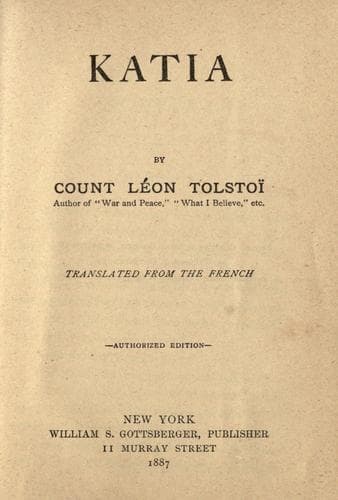
Man-woman relationships -- Fiction; Marriage -- Fiction; Russia -- Social life and customs -- 19th century -- Fiction
Spring came. Macha and Sonia returned to the country for the summer; and
as Nikolski was undergoing repairs, we went with them to Pokrovski. The
same old home, the terrace, the out-of-door tea-table, the piano in the
half-lighted room, my own old chamber with its white curtains, and the
girlish dreams which seemed to have been left behind there, forgotten.
In this chamber were two beds; over one, which had been my own, I now
bent nightly to bless my sturdy Kokocha,[H] in the midst of his bedtime
frolics; in the other lay little Vasica,[I] his baby-face rosy with
sleep, under the soft white blankets. After giving the benediction, I
often lingered a long time in this peaceful chamber, and from every
corner of its walls, from every fold of its curtains, came stealing
around me forgotten visions of my youth; childish songs, gay choruses,
floated again to my ears. And what were they now,--these visions? Were
they sounding still, anywhere,--these glad and sweet old songs? All that
I had hardly dared to hope had come true. My vague and confused dreams
had become reality, and it was now my life, so hard, so heavy, so
stripped of joy. And yet here around me were not all things as before?
Was it not the same garden that I saw beneath my window, the same
terrace, the same paths and benches? Far off there, across the ravine,
the songs of the nightingales still seemed to rise out of the ripples of
the little pond, the lilacs bloomed as they used to do, the moon still
stood in white glory over the corner of the house, yet for me all was so
changed, so changed! Macha and I had our old quiet talks, sitting
together as of old in the salon, and we still talked of him. But Macha's
brow was grave, her face was wan, her eyes no longer shone with
contentment and hope, but were full of sad sympathy, and almost
expressed compassion. We no longer went into ecstasies over him, as in
the past; we judged him, now; we no longer marvelled at our great
happiness and wondered how it came to be ours, we no longer had the
impulse to tell all the world what we felt; we whispered in each other's
ear like conspirators; for the hundredth time we asked each other why
all was so sad, so changed. As for him, he was still the same, except
that the line between his brows was deeper, and his temples were more
silvery, and his eyes, watchful, deep, continually turned away from me,
were darkened by a shadow. I, too, was still the same, but I no longer
felt either love or desire to love. No more wish to work, no more
satisfaction with myself. And how far off, how impossible, now appeared
my old religious fervor, my old love for him, my old fulness of life! I
could not, now, even comprehend what in those days was so luminous and
so true: the happiness of living for others. Why for others? when I no
longer wished to live for myself....
I had entirely given up my music during our residence in St. Petersburg,
but now my old piano and my old pieces brought back the love for it.
Public-domain text, read in full here on John Shaqi.
Reviews
Reviews
No reviews yet
Be the first to share your thoughts on this work.
Join the Discussion
Join the discussion
Sign in to leave a comment or review.
Sign InorCreate an account