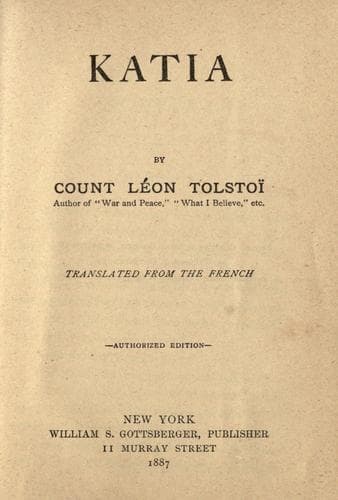
Man-woman relationships -- Fiction; Marriage -- Fiction; Russia -- Social life and customs -- 19th century -- Fiction
"We have read his work conscientiously, and, we confess, with profit.
Never have we had so clear an insight into the manners, thoughts, and
feelings of the ancient Greeks. No study has made us so familiar with
the age of Pericles. We recognize throughout that the author is master
of the period of which he treats. Moreover, looking back upon the work
from the end to the beginning, we clearly perceive in it a complete
unity of purpose not at all evident during the reading."
"Hamerling's Aspasia, herself the most beautiful woman in all Hellas, is
the apostle of beauty and of joyousness, the implacable enemy of all
that is stern and harsh in life. Unfortunately, morality is stern, and
had no place among Aspasia's doctrines. This ugly fact, Landor has
thrust as far into the background as possible. Hamerling obtrudes it. He
does not moralize, he neither condemns nor praises; but like a fate,
silent, passionless, and resistless, he carries the story along, allows
the sunshine for a time to silver the turbid stream, the butterflies and
gnats to flutter above it in rainbow tints, and then remorselessly draws
over the landscape gray twilight. He but follows the course of history;
yet the absolute pitilessness with which he does it is almost
terrible."--_Extracts from Review in Yale Literary Magazine._
"No more beautiful chapter can be found in any book of this age than
that in which Pericles and Aspasia are described as visiting the poet
Sophocles in the garden on the bank of the Cephissus."--_Utica Morning
Herald._
"It is one of the great excellencies of this romance, this lofty song of
the genius of the Greeks, that it is composed with perfect artistic
symmetry in the treatment of the different parts, and from the first
word to the last is thoroughly harmonious in tone and coloring.
Therefore, in 'Aspasia,' we are given a book, which could only proceed
from the union of an artistic nature and a thoughtful mind--a book that
does not depict fiery passions in dramatic conflict, but with dignified
composure, leads the conflict therein described to the final
catastrophe."--_Allgemeine Zeitung._ (Augsburg).
_William S. Gottsberger, Publisher, New York._
* * * * *
=ELIZABETH=; OR THE EXILES OF SIBERIA.--From the French of =Mme.
Sophie Cottin=, one vol. Paper, 25 cents. Cloth, 50 cents.
Public-domain text, read in full here on John Shaqi.
Reviews
Reviews
No reviews yet
Be the first to share your thoughts on this work.
Elsewhere in the archive
Join the Discussion
Join the discussion
Sign in to leave a comment or review.
Sign InorCreate an account