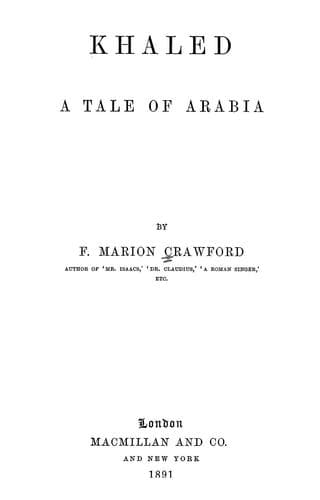
Khaled, A Tale of ArabiaCrawford, F. Marion (Francis Marion)
Science
Khaled, A Tale of Arabia
Crawford, F. Marion (Francis Marion)
Arabian Peninsula -- Fiction
Abdullah ibn Mohammed, though a young man, was now the sheikh of a
considerable tribe which had frequently done good service to the late
Sultan, Zehowah's father, and which had also borne a prominent part in
the recent war. Abdul Kerim, whom Almasta had murdered, had been the
sheikh during his lifetime, and if the claims of birth had been justly
considered, his son, though a mere boy, should have succeeded him. But
Abdullah had found it easy to usurp the chief place, and in the council
which was held after Abdul Kerim's death he was chosen by acclamation.
It chanced, too, that he was not married at the time when he took
Almasta, for of two wives the one had died of a fever during the summer,
and he had divorced the other on account of her unbearable temper,
having been deceived in respect of this by her parents, who had assured
him that she was as gentle as a dove and as submissive as a lamb. But
she had turned out to be as quarrelsome as a wasp and as unmanageable as
an untrained hawk, so he divorced her, and the more readily because she
was not beautiful and her dower had been insignificant. Almasta
therefore found that she was her husband's only wife.
She would certainly have killed him, as she had killed Abdul Kerim, and,
indeed, the late Sultan, in the hope of being taken back into the
palace, but she was prevented by the fear of death, for she had seen
that Khaled's threat was not empty and would be executed if harm came to
Abdullah after his marriage. She accordingly set herself to please him,
and first of all she learned to speak the Arabic language, in order that
she might sing to him in his own tongue and tell him tales of distant
countries, which she had learned in her own home.
Abdullah passed the months of autumn and the early winter in the desert,
moving about from place to place, as is the custom of the Bedouins, it
being his intention to reach a northerly point of Ajman in the spring,
in order to fall upon the Persian pilgrims and extort a ransom before
they entered the territory of Nejed. For it would not be lawful to
attack them after that, since there was a treaty with the Emir of
Basrah, allowing the pilgrims a safe and free passage towards Mecca, for
which the Emir paid yearly a sum of money to the Sultan of Nejed.
But Almasta knew nothing of this, for she was wholly ignorant of the
desert; and moreover Abdullah was a cautious man, who held that
whatsoever is to be kept secret must not be uttered aloud, though there
be no one within three days' journey to hear it.
Public-domain text, read in full here on John Shaqi.
Reviews
Reviews
No reviews yet
Be the first to share your thoughts on this work.
Elsewhere in the archive
Join the Discussion
Join the discussion
Sign in to leave a comment or review.
Sign InorCreate an account