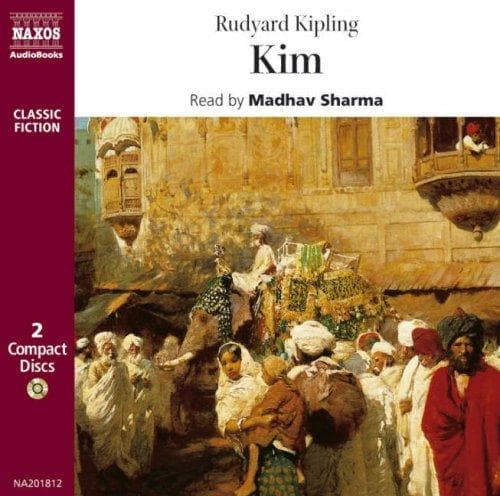
Adventure stories; Boys -- Fiction; India -- Fiction; Irish -- India -- Fiction; Lamas -- Fiction; Orphans -- Fiction; Spy stories
Kim lit a rank cigarette—he had been careful to buy a stock in the
bazar—and lay down to think. This solitary passage was very different
from that joyful down-journey in the third-class with the lama. “Sahibs
get little pleasure of travel,” he reflected. “_Hai mai!_ I go from one
place to another as it might be a kickball. It is my _Kismet_. No man
can escape his _Kismet_. But I am to pray to Bibi Miriam, and I am a
Sahib.” He looked at his boots ruefully. “No; I am Kim. This is the
great world, and I am only Kim. Who is Kim?” He considered his own
identity, a thing he had never done before, till his head swam. He was
one insignificant person in all this roaring whirl of India, going
southward to he knew not what fate.
Presently the Colonel sent for him, and talked for a long time. So far
as Kim could gather, he was to be diligent and enter the Survey of
India as a chain-man. If he were very good, and passed the proper
examinations, he would be earning thirty rupees a month at seventeen
years old, and Colonel Creighton would see that he found suitable
employment.
Kim pretended at first to understand perhaps one word in three of this
talk. Then the Colonel, seeing his mistake, turned to fluent and
picturesque Urdu and Kim was contented. No man could be a fool who knew
the language so intimately, who moved so gently and silently, and whose
eyes were so different from the dull fat eyes of other Sahibs.
“Yes, and thou must learn how to make pictures of roads and mountains
and rivers, to carry these pictures in thine eye till a suitable time
comes to set them upon paper. Perhaps some day, when thou art a
chain-man, I may say to thee when we are working together: ‘Go across
those hills and see what lies beyond.’ Then one will say: ‘There are
bad people living in those hills who will slay the chain-man if he be
seen to look like a Sahib.’ What then?”
Kim thought. Would it be safe to return the Colonel’s lead?
“I would tell what that other man had said.”
“But if I answered: ‘I will give thee a hundred rupees for knowledge of
what is behind those hills—for a picture of a river and a little news
of what the people say in the villages there’?”
“How can I tell? I am only a boy. Wait till I am a man.” Then, seeing
the Colonel’s brow clouded, he went on: “But I think I should in a few
days earn the hundred rupees.”
“By what road?”
Kim shook his head resolutely. “If I said how I would earn them,
another man might hear and forestall me. It is not good to sell
knowledge for nothing.”
“Tell now.” The Colonel held up a rupee. Kim’s hand half reached
towards it, and dropped.
“Nay, Sahib; nay. I know the price that will be paid for the answer,
but I do not know why the question is asked.”
“Take it for a gift, then,” said Creighton, tossing it over. “There is
a good spirit in thee. Do not let it be blunted at St Xavier’s. There
are many boys there who despise the black men.”
Public-domain text, read in full here on John Shaqi.
Reviews
Reviews
No reviews yet
Be the first to share your thoughts on this work.
Join the Discussion
Join the discussion
Sign in to leave a comment or review.
Sign InorCreate an account