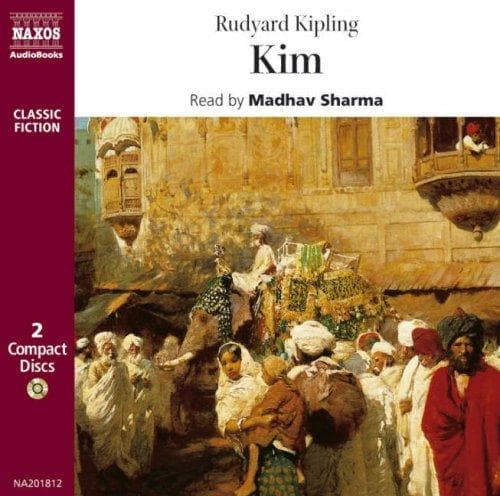
Adventure stories; Boys -- Fiction; India -- Fiction; Irish -- India -- Fiction; Lamas -- Fiction; Orphans -- Fiction; Spy stories
“Their mothers were bazar-women,” said Kim. He knew well there is no
hatred like that of the half-caste for his brother-in-law.
“True; but thou art a Sahib and the son of a Sahib. Therefore, do not
at any time be led to contemn the black men. I have known boys newly
entered into the service of the Government who feigned not to
understand the talk or the customs of black men. Their pay was cut for
ignorance. There is no sin so great as ignorance. Remember this.”
Several times in the course of the long twenty-four hours’ run south
did the Colonel send for Kim, always developing this latter text.
“We be all on one lead-rope, then,” said Kim at last, “the Colonel,
Mahbub Ali, and I—when I become a chain-man. He will use me as Mahbub
Ali employed me, I think. That is good, if it allows me to return to
the Road again. This clothing grows no easier by wear.”
When they came to the crowded Lucknow station there was no sign of the
lama. He swallowed his disappointment, while the Colonel bundled him
into a _ticca-gharri_ with his neat belongings and despatched him alone
to St Xavier’s.
“I do not say farewell, because we shall meet again,” he cried. “Again,
and many times, if thou art one of good spirit. But thou art not yet
tried.”
“Not when I brought thee”—Kim actually dared to use the _tum_ of
equals—“a white stallion’s pedigree that night?”
“Much is gained by forgetting, little brother,” said the Colonel, with
a look that pierced through Kim’s shoulder-blades as he scuttled into
the carriage.
It took him nearly five minutes to recover. Then he sniffed the new air
appreciatively. “A rich city,” he said. “Richer than Lahore. How good
the bazars must be! Coachman, drive me a little through the bazars
here.”
“My order is to take thee to the school.” The driver used the “thou”,
which is rudeness when applied to a white man. In the clearest and most
fluent vernacular Kim pointed out his error, climbed on to the
box-seat, and, perfect understanding established, drove for a couple of
hours up and down, estimating, comparing, and enjoying. There is no
city—except Bombay, the queen of all—more beautiful in her garish style
than Lucknow, whether you see her from the bridge over the river, or
from the top of the Imambara looking down on the gilt umbrellas of the
Chutter Munzil, and the trees in which the town is bedded. Kings have
adorned her with fantastic buildings, endowed her with charities,
crammed her with pensioners, and drenched her with blood. She is the
centre of all idleness, intrigue, and luxury, and shares with Delhi the
claim to talk the only pure Urdu.
“A fair city—a beautiful city.” The driver, as a Lucknow man, was
pleased with the compliment, and told Kim many astounding things where
an English guide would have talked of the Mutiny.
Public-domain text, read in full here on John Shaqi.
Reviews
Reviews
No reviews yet
Be the first to share your thoughts on this work.
Join the Discussion
Join the discussion
Sign in to leave a comment or review.
Sign InorCreate an account