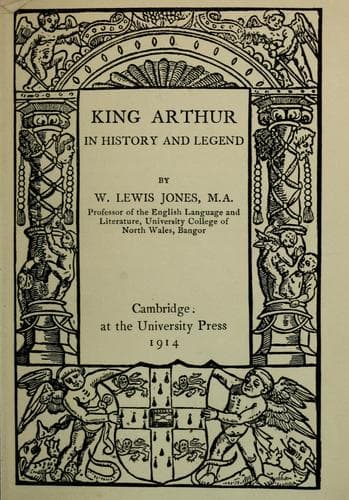
King Arthur in history and legendJones, William Lewis
History
King Arthur in history and legend
Jones, William Lewis
Arthur, King; Arthurian romances -- History and criticism
_Note F, p. 115._--Malory, it should be said, is indebted for some of
his most picturesque touches in his account of the passing of Arthur
and of other incidents to an unknown English poet who, probably in
the fourteenth century, composed a metrical _Le Morte Arthure_. As
the first edition of the present book has been accused of having
done “grave injustice to our vernacular Arthurian literature before
Malory” through failure to recognise the merits of “the unknown but
most true poet whose rightful laurels have so long been worn by the
prose writer,” an extract from the poem may be given in order to enable
the reader to judge to which of the two, from a purely literary point
of view, the “rightful laurels” ought to belong. Here is the poet’s
account of the flinging of Excalibur:--
“The knyght was bothe hende and free;
To save that swerd he was fulle glad,
And thought, whethyr it better bee
Yif neuyr man it after had;
An I it caste in to the see,
Off mold was neuyr man so mad.
The swerd he hyd undyr a tree,
And sayd, ‘syr, I ded as ye me bad.’
‘What saw thow there?’ than sayd the kynge,
‘Telle me now, yiff thow can;’
‘Sertes, syr,’ he said, ‘nothynge
But watres depe, and waives wanne,’
‘A, now thou haste broke my byddynge!
Why hast thou do so, thow false man?
Another bode thou muste me brynge,’” etc.
_Note G, p. 130._--It would be impossible, within the limits of such a
book as this, to pass in review all the English Arthurian literature
of the nineteenth century. William Morris’s _Defence of Guinevere_,
_King Arthur’s Tomb_, and other Arthurian poems doubtless breathe much
more of the primitive romantic spirit of the legends than Tennyson’s
_Idylls_, but they are but slight experiments in comparison with
Tennyson’s elaborate design. Then there are other works like Heber’s
_Morte Arthur_, Lytton’s _King Arthur_, and Hawker of Morwenstow’s
_Quest of the Sangreal_, which claim a place in any full survey of
modern Arthurian literature, but are hardly of sufficient importance
to have required notice in so brief a chapter as the last had,
necessarily, to be.
BIBLIOGRAPHY
[The following list comprises only a brief selection of books likely to
be of most use and interest to the English reader. Welsh, French and
German authorities are left entirely out of account.]
Six Old English Chronicles. Translated by J. A. Giles. Bohn’s Series.
(Contains useful translations of Gildas, Nennius, and Geoffrey of
Monmouth.)
Geoffrey of Monmouth. History of the Kings of Britain, translated by
Dr Sebastian Evans. The Temple Classics (Dent).
The Four Ancient Books of Wales. Edited, with translations, by Dr W.
F. Skene. Edinburgh, 1868.
The Mabinogion. Translated by Lady Charlotte Guest. The best popular
edition is that of A. Nutt, and is especially valuable for his
critical notes at the end.
Layamon’s Brut. Edited by Sir F. Madden. 3 vols. London, 1847.
Public-domain text, read in full here on John Shaqi.
Reviews
Reviews
No reviews yet
Be the first to share your thoughts on this work.
Elsewhere in the archive
Join the Discussion
Join the discussion
Sign in to leave a comment or review.
Sign InorCreate an account