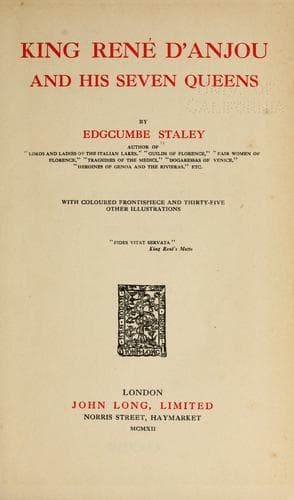
King René d'Anjou and His Seven QueensStaley, Edgcumbe
History
King René d'Anjou and His Seven Queens
Staley, Edgcumbe
France -- Court and courtiers; René I, King of Naples and Jerusalem, 1409-1480
Marie, though the consort of a fugitive penniless King, had a suite
worthy of herself and of her parentage and rank; the Queen-mother saw
to that. Her Controller was Hardoin de Mailly, and her Master of Horse
Jacques Odon de Maulevrier, a devoted friend of her brother, Duke René.
The Queen’s four _Dames d’Honneur_ were Catherine Bourgoing, Aimée de
Beauvais, Philippe de la Rochefoucault, and Jeanne Sorel. Her Maids
of Honour were Marie du Couldray, Jeanne de la Grosse, Catherine de
Beauvais, Jeannett la Garrelle, Hervée Catherine de Montplaie, and
Jehanne Biardelle, with three quite young girls whose Christian names
alone have been preserved--Felize, Geffeline, and Jacquette--perhaps
pet names.
Duke René, ever a liberal-minded and open-handed Prince, gave each of
his sister’s ladies a robe of richest _aigneaulx_ fur, with crimson
satin lining, and twenty skins of martens for bordering their kirtle
bodices. Each robe cost 16 florins (= £12), and was supplied by the
Queen-mother’s furrier at Angers, one Martin Chebiton.
The immodest fashions set by Queen Isabeau and the ladies of her
Court, and their outrageous modes of headgear, did not go unrebuked by
the better sort of clergy. A very famous preaching friar, one Thomas
Correcte, a Carmelite monk from Brittany, in particular inaugurated
a crusade against feminine extravagances through the North of France
and in Flanders during the second decade of the fifteenth century.
He further strenuously denounced the dignified clergy who kept
fashionable mistresses. He was welcomed heartily by the burghers of
the towns through which he passed, and conducted to a special pulpit
erected in the market-place, adorned with rich hangings and a gigantic
crucifix. Guards of honour and musicians were at his service, and, in
spite of opposition and natural predilections, the clergy fell into
line with the popular fancy, and rang their bells on his arrival. His
denunciations were quite in accord with the feelings of the people,
but they incited the rougher element to take the law into their own
hands. Squads of youths paraded the public thoroughfares in search
of errant dames, and no sooner had their gaze alighted upon a lady
of degree, coiffured _à l’outrance_, than a flight of stones, deftly
aimed, quickly made havoc of her headgear. The popular cry, “_Un
hennin! un hennin! à bas les hennins!_” produced a panic, so that the
women dared hardly sally forth from their own doors. It was said that
the friar personally organized these demonstrations, and even paid
the lads to disenchant the fair sex by forcibly pulling down their
hideous superstructures. At all events, women with dishevelled heads
and disordered attire ran hither and thither helpless and defenceless.
The worthy and enthusiastic evangelist had, however, an alternative
fashion with which modest women might cover their heads and breasts.
He prescribed the universal habit of wearing plain _chapelles_, the
ordinary caps of peasant women.
Public-domain text, read in full here on John Shaqi.
Reviews
Reviews
No reviews yet
Be the first to share your thoughts on this work.
Elsewhere in the archive
Join the Discussion
Join the discussion
Sign in to leave a comment or review.
Sign InorCreate an account