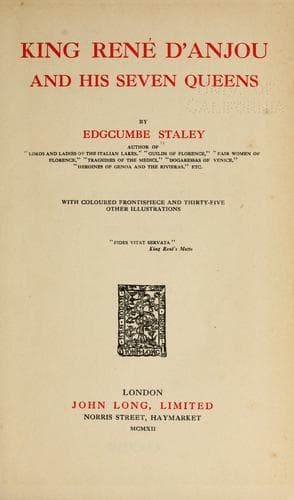
King René d'Anjou and His Seven QueensStaley, Edgcumbe
History
King René d'Anjou and His Seven Queens
Staley, Edgcumbe
France -- Court and courtiers; René I, King of Naples and Jerusalem, 1409-1480
such never fails between kindred souls, though parted by hemispheres.
René was a just man still, and a true knight. Jeanne likened him to her
own St. Michael.
All through Jeanne’s ordeals,--first the open scoffs of the courtiers
and servitors at Chinon, then the covert jeers of the divines and
busybodies at Poitiers, and lastly the base insinuations of libertines
and adventurers,--the Queen stood by La Pucelle. Queen Yolande’s panel
of matrons found Marie’s tribute of the utmost value; she staked her
royal prerogative upon the girl’s absolute chastity, and the prying,
posturing Court bowed to her decision.
If Queen Yolande clothed the maid in shining armour within the great
Hall of Audience of Angers Castle, on the eve of the advance upon
Orléans, Queen Marie knelt with her in prayer in the solemn choir of
Angers Cathedral from Vespers to Compline. How much of her strength
of will and the promptness of her action Jeanne d’Arc gained from the
whole-hearted favour of these two good Queens the world may never know,
but this much we all can apprehend: that unselfish human sympathy is a
more mobile force than the uncertainties of Providence.
We can never know why Queen Marie was denied the satisfaction of
witnessing and sharing in the coronation of Charles at Reims. She was
living quietly at Bourges when the King set off for the metropolitical
cathedral under the conduct of La Pucelle and of her brother René. She
was prepared for the expedition, and her robes of state were ready for
the ceremony, when suddenly Charles commanded her to remain where she
was, saying that the march was full of dangers and quite impossible
for the Queen and her ladies. La Pucelle begged the King to recall
his prohibitions, saying that Queen Marie was quite as worthy as was
he to receive a crown. The poor Queen put by her finery,--perhaps not
altogether sorrowfully,--and went to reflect awhile at Gien upon the
untowardness of human affairs in general and the inconsequences of
Charles in particular. Her parting with Jeanne was affecting; Queen and
peasant embraced each other affectionately--and never more they met.
II.
Public-domain text, read in full here on John Shaqi.
Reviews
Reviews
No reviews yet
Be the first to share your thoughts on this work.
Elsewhere in the archive
Join the Discussion
Join the discussion
Sign in to leave a comment or review.
Sign InorCreate an account