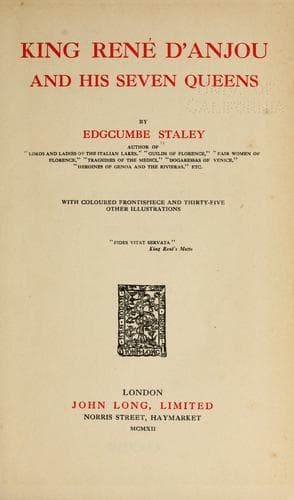
King René d'Anjou and His Seven QueensStaley, Edgcumbe
History
King René d'Anjou and His Seven Queens
Staley, Edgcumbe
France -- Court and courtiers; René I, King of Naples and Jerusalem, 1409-1480
King Charles was not with his sweetheart in her death, but he grieved
and rocked himself in woe. “Because she was what she was,” he sobbed,
“for that I mourn.” He hastened to Jumièges, and with every mark of
sincere affection he assisted in placing his Agnes in her coffin. Her
heart he had enclosed in a costly gold vase, which he carried about
with him wherever he went, and when he died it was deposited by his
command beneath a black marble slab in front of the high-altar of
Jumièges, with the simple epitaph: “Agnes Seurelle--Dame de Breauté.”
Fair Agnes’s body, still comely in death, was ultimately translated
by Charles to Loches, and interred in the basement of the King’s
Apartments. Her tomb, surmounted by a statue, was erected by her royal
lover. Upon a block marble bed reclines a white marble effigy of “_la
Belle des Belles_,” evidently sculptured after life. The fascinating
features with her sweet smile are beautifully chiselled, and the
graceful figure lightly covered by a long chemise admirably exhibits
her exquisitely-proportioned form.
Agnes, in a will she made a year before her death, directed that her
body should rest at Jumièges, and she bequeathed 1,000 _écus d’or_ (=
£500) to the monastery for Masses for the rest of her soul. She had
for years been a munificent benefactress to the clergy of the abbey.
When Charles had joined his sweetheart in the Paradise of Love, the
ungrateful monks were desirous of removing Agnes’s heart and its
memorial tablet, on the score that she had led an immoral life; but
Louis XI., in spite of his fierce hatred of his father’s mistress,
reproved the religious, and warned them that, if they determined to
cast out her remains, they must also divest themselves of the gifts and
legacies of their patroness. “If you,” the new King said, “disturb her
ashes, I shall expect you to hand over to me the gold _écus_.” Needless
perhaps to say, the worldly-wise Canons kept the money and the heart.
The death of Agnes Sorel had a terrible effect upon the subsequent life
of Charles the King. She and Queen Marie between them had managed to
keep him free from amorous imbroglios, but now, with only his wife’s
protestations to guard him, he gave way to immoderate indulgences, and
he, to quote the French,--“_enlardit sa vie de tenir males femmes en
son hostel!_”
III.
Public-domain text, read in full here on John Shaqi.
Reviews
Reviews
No reviews yet
Be the first to share your thoughts on this work.
Elsewhere in the archive
Join the Discussion
Join the discussion
Sign in to leave a comment or review.
Sign InorCreate an account