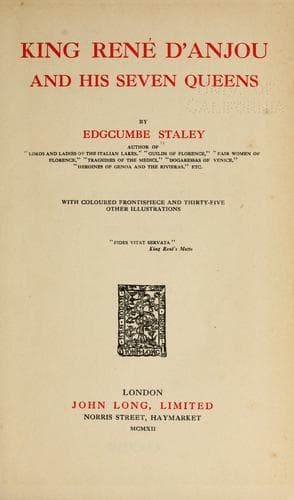
King René d'Anjou and His Seven QueensStaley, Edgcumbe
History
King René d'Anjou and His Seven Queens
Staley, Edgcumbe
France -- Court and courtiers; René I, King of Naples and Jerusalem, 1409-1480
A bright day dawned for Queen Marie. It was the Festival of the
Forerunner, June 24, 1436, and the ancient and loyal city of Tours
was decked for the royal nuptials of the Dauphin. The King and Queen
of France with the good Queen Yolande and their suite awaited at the
Château du Plessis-lès-Tours the arrival of the young bridal couple.
Louis had gone to meet his bride at Saumur; he was but a boy of
thirteen, small, ill-looking, and not too clever. Princess Margaret,
daughter of James I. of Scotland, with a following of Scottish nobles
and Maids of Honour, a tall, sprightly girl of twelve, vastly enjoyed
her voyage, and clapped her hands delightedly at the flowers and fruits
of Anjou. She embraced her little husband-to-be, and took him by the
hand as they stepped on board the state barge in waiting at the river
quay.
Among the bevy of fair maidens who welcomed the royal bride was
Jehanne de Laval, who was attached to the suite of the Dauphiness.
The grand hall of the castle and state-rooms were hung with tapestry
and lengths of cloth of gold. There the Sovereigns were seated on a
canopied daïs, wearing their crowns and robes of state. The little
Princess entered the Presence somewhat nervously, still holding the
hand of the young Dauphin, and chaperoned by her Scottish Mistress
of the Robes. Making a graceful obeisance, Margaret advanced with
childlike confidence, and Queen Marie, rising, went to greet her young
daughter-in-law; she embraced her tenderly, and introduced her to the
King and to Queen Yolande. The courtiers pressed forward to kiss the
Princess’s hand, and many costly gifts were laid at her feet. Wearied
at length with the ceremonies, Queen Marie conducted her interesting
visitor to her own apartments, where dinner was served.
The bells of all the churches in Tours set up merry janglings at dawn
next day, and the cathedral was crowded by a goodly company of wedding
guests. The King and the two Queens were seated on their thrones.
Charles wore a black velvet doublet and hose, his _berretta_ was of
red, and he bore round his neck a decoration sent from the King of
Scotland. The Queen was arrayed in crimson velvet and ermine. She wore
an abbreviated _hennin_ with a fine lace fall; her hair was embroidered
with gold. The young Prince was in blue and silver, his bride in
bridal white. Everybody bore wedding favours--Scottish heather and
French lilies entwined with white satin ribbons. The Archbishop of
Reims performed the ceremony, accompanied by a number of Bishops and
dignified clergy.
Public-domain text, read in full here on John Shaqi.
Reviews
Reviews
No reviews yet
Be the first to share your thoughts on this work.
Elsewhere in the archive
Join the Discussion
Join the discussion
Sign in to leave a comment or review.
Sign InorCreate an account