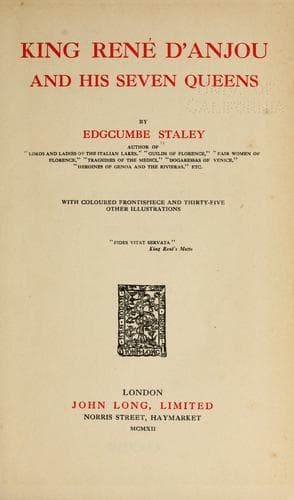
King René d'Anjou and His Seven QueensStaley, Edgcumbe
History
King René d'Anjou and His Seven Queens
Staley, Edgcumbe
France -- Court and courtiers; René I, King of Naples and Jerusalem, 1409-1480
Queen Marie’s other son, Charles, Duc de Berry, the last of all her
surviving children, born December 28, 1446, was a Prince of no strength
of character. Easily led by others, he became involved in endless
imbroglios, and aided and abetted his elder brother the Dauphin, in
his unfilial conduct towards their father. Created Duke of Guienne and
Duke of Normandy in 1469,--after the expulsion of the English,--he
was a source of constant anxiety and trouble to his mother. The Queen
of Sicily-Anjou, Isabelle de Lorraine, his godmother, with King
René, took the young Prince in hand, but he did not well repay their
solicitude. Immoral, dissipated, and in debt, Charles de Berry spent
his time in debauches and intrigues; he was own grandson of Isabeau the
Infamous. Among his many mistresses, Derouillée de Montereau, widow
of Louis d’Amboise, exercised the greatest influence. She, too, was
the cause of his death, for at lunch one day she placed a peach in his
wineglass, and she challenged Charles to bite the fruit with her. Her
half she swallowed, and she fell dead in a few minutes, whilst her
royal paramour lingered in acute suffering for three whole days, and at
last succumbed to the poison on May 28, 1472. Whether she caused the
fruit to be poisoned we know not; most likely she knew all about it,
and only followed in the steps of those whose immorality turns love to
hate and sanctity to madness. This was a characteristic of society in
the Renaissance, the cloven hoof of the old Adam showing beneath the
sumptuous garments of the new man.
As might very well have been expected at a Court of self-seekers
and sycophants, the integrity and unselfishness of the Queen were
goads to slander and aids to hypocrisy. She was assailed on account
of her absolute faithfulness to the marriage bond and for her want of
personal ambition. Roués could not understand her; mondaines would
not tolerate her; the King’s favourites and mistresses,--not Agnes
Sorel, be it said,--strove all they could to poison his mind against
his consort. The names of many prominent Princes and courtiers were
linked scandalously with the Queen’s. Arthur de Richemont, son of
Duke Jehan VI. of Brittany, the Constable of France; Pierre de Giac
de la Trémouille, Captain of the King’s Guards; Étienne Louvet,
President of the Privy Council; and the Count of Dunois, better known
as the “Bastard of Orléans,” were all said to have shared the Queen’s
confidences and her favours. The latter was thrown, indeed, very much
with Her Majesty, and ranked among the Princes of the Royal House. Son
of the assassinated Duke of Orléans by an unknown mother, the Duchess
brought him up along with her own children, and she hoped he would live
to avenge his father’s death. The “Bastard” was the playmate of the
children of King Louis II. of Sicily-Anjou and Queen Yolande, and he
and the Princess Marie were much drawn to one another.
Public-domain text, read in full here on John Shaqi.
Reviews
Reviews
No reviews yet
Be the first to share your thoughts on this work.
Elsewhere in the archive
Join the Discussion
Join the discussion
Sign in to leave a comment or review.
Sign InorCreate an account