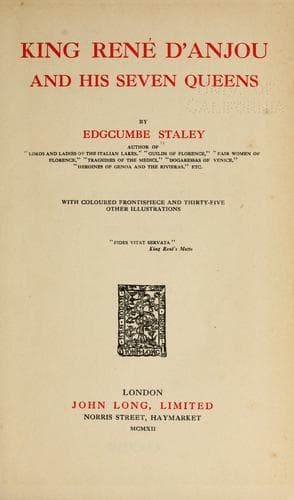
King René d'Anjou and His Seven QueensStaley, Edgcumbe
History
King René d'Anjou and His Seven Queens
Staley, Edgcumbe
France -- Court and courtiers; René I, King of Naples and Jerusalem, 1409-1480
“We have noted that our brother the King of Sicily (René) has
in his house at Rivetes, of which you, Guillaume Bernart,
have the superintendence, some cocks and hens of good strain,
and that they are very fine, as we have seen. If you are well
disposed, then, the messenger can bring us a cock and a hen,
with a broody hen and her chicks. You will see that they are
in good condition. Do not be at all fearful of displeasing our
royal brother, for we shall make him both pleased and happy.
“Dearly beloved, may Our Lord protect you. Written at our
Castle of Chinon, XVI. day of July, 1458.
“MARIE.”
King René had a farm at Rivetes, and from an inventory dated November
12, 1458, we learn that he had--“69 _chés d’animaille_ (heads of
stock), 1 _jument_ (mare), 1 _poulain_ (colt), 42 _chés de pourceaux_
(pigs), and much poultry.” Rivetes, with its forest of chestnuts, was
situated between the rivers Loire and Anthion, at no great distance
from Angers. René had also wild beasts and birds--a vast menagerie
at Rivetes and Reculée. His keeper of lions and leopards in 1476 was
Benoist Bagonet, and of his eagles and peacocks, Vissuel Gosmes. He had
also at Reculée a Court fool, Triboullet. They were all very pleasant
fellows, and helped to amuse the King and Queen and their guests.
King Charles VII. died at his favourite castle of Mehun-sur-Yèvre, July
22, 1461. He had suffered for a considerable time from an incurable
ulcer in his mouth, which denied him the pleasure and necessity of
eating. In his last illness Marie was at Chinon; he cried piteously for
her to come to him: “_Marie, ma Marie!_” She hastened to Mehun, and
was in time to hold his hand and moisten his heated brow, and quietly
he died in her arms--the arms of the truest of wives and noblest of
queens. Charles was buried in the royal vaults at St. Denis, and
Louis XI., his son, reigned in his stead. Devoted to his mother, her
widowhood was lightened by his affectionate regard. His father’s death
made no difference in her royal state; the King placed his mother
before his wife--Charlotte of Savoy.
Public-domain text, read in full here on John Shaqi.
Reviews
Reviews
No reviews yet
Be the first to share your thoughts on this work.
Elsewhere in the archive
Join the Discussion
Join the discussion
Sign in to leave a comment or review.
Sign InorCreate an account