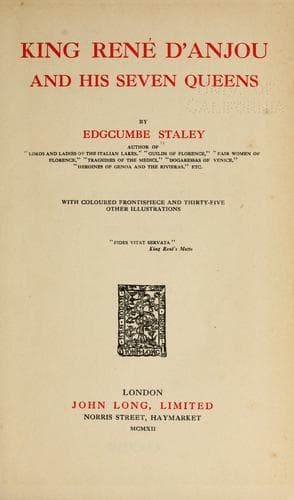
King René d'Anjou and His Seven QueensStaley, Edgcumbe
History
King René d'Anjou and His Seven Queens
Staley, Edgcumbe
France -- Court and courtiers; René I, King of Naples and Jerusalem, 1409-1480
The portrait was painted exactly to order--perhaps, and quite
correctly, with a little artistic embellishment. The beauty of Nature
is always enhanced by the decorative features of art. Henry was charmed
with the sweet face he gazed and gazed upon, quite putting into the
shade the other reigning beauties of his heart. He was himself as
comely as might be, just four-and-twenty, highly educated, his mind
unusually refined. In thought and deed he was pure and devout, and very
shy of strange women. Upon the latter head he was emphatic, for when
at Court or elsewhere he beheld women with open bosoms _à l’Isabeau
de Bavière_ he was shocked, and turned away his face, muttering: “Oh
fie! oh fie! ye be much to blame!” His earnest wish was marriage, not
concubinage. The King’s choice very soon became noised abroad, and the
Court became agitated and divided. The Duke of Gloucester, the King’s
next of kin and heir-presumptive to the throne, championed the Armagnac
match, whilst Cardinal Beaufort and the Earl of Suffolk decided for
Margaret of Anjou.
There was, however, an obstacle in the way, quite consistently with
the proverbial rugged course of all true love; the Count of Nevers
refused to release his fiancée. He was prepared, he averred, to cancel
the contentious clause in the marriage contract, made at Tarascon, and
not to insist upon anything derogatory to the dignity of King René
and his elder daughter, the Countess Ferri de Vaudémont. The prospect
to René of such an auspicious union, however, which would place his
daughter upon one of the greatest of European thrones, was too dazzling
to be ignored, and the outcome of the imbroglio was the assembling in
January, 1444, of a mixed Commission, representing England, France,
Anjou, and Burgundy, at Tours, whereat two protocols were framed: a
treaty for a two years’ peace, and a marriage agreement between the
King of England and the Princess of Anjou. This was signed on May 28 of
the same year. The marriage contract thus drawn out was very favourable
to the House of Sicily-Anjou: Henry asked for no dowry, but required
only the rights transmitted to King René by Queen Yolande with respect
to the kingdom of Minorca. Henry further agreed to the retrocession of
Le Mans and other points in Anjou held by the English.
Public-domain text, read in full here on John Shaqi.
Reviews
Reviews
No reviews yet
Be the first to share your thoughts on this work.
Elsewhere in the archive
Join the Discussion
Join the discussion
Sign in to leave a comment or review.
Sign InorCreate an account