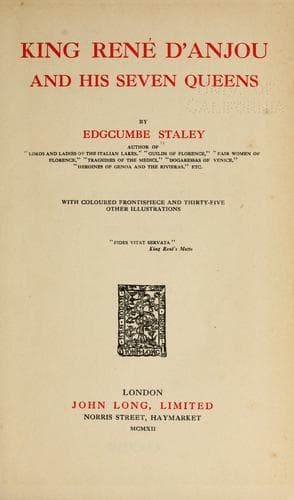
King René d'Anjou and His Seven QueensStaley, Edgcumbe
History
King René d'Anjou and His Seven Queens
Staley, Edgcumbe
France -- Court and courtiers; René I, King of Naples and Jerusalem, 1409-1480
Bare-headed, King René stood at the castle portal till Margaret and her
escort had faded from his sight; then he and the Queen shut themselves
up in their apartments and gave way to their pent-up feelings.
Travelling as the Queen of England, Margaret had now for her supporters
her brother, the Duke of Calabria, the Duke of Alençon, and the
courteous Marquis of Suffolk. Leisurely enough the company traversed
the fertile fields of Champagne, ever aiming for the north French
coast. Besides a strong escort of soldiery, in the royal train were
seventeen knights and two esquire-carvers, sixty-five esquires, twenty
grooms, and 174 servitors of all kinds, and with them serving-maids and
dressers. At every stopping-place heartiest greetings awaited the young
Queen, and Princes and nobles knelt to pay their homage. The English
garrisons _en route_ were forward in their loyal salutations; their new
Queen was the pledge of a greatly-yearned-for _entente cordiale_.
At Nantes the Duke of York, King Henry’s near kinsman, and the
representative of the older line of the English Royal House, received
the Queen, and entertained her in the castle of the French Kings. On
March 23 the royal progress ended at Rouen, where a week’s rest was
called. Bicknoke, in his “_Computus_,” has enumerated several curious
items in the bill of costs which covered the lengthy journey from
Lorraine. The Barons and Baronesses of the Queen’s suite received each
four shillings and sixpence a day, the knights had half a crown each a
day, and, at the tail of the following, the grooms were paid no more
than fourpence per diem. At Rouen the Queen paid four shillings and
ninepence for fourteen pairs of shoes to give to certain poor women of
the town. She also made many purchases of second-hand silver plate from
a silversmith, Jean Tubande by name. The articles were chiefly cups and
plates which bore the arms of Henry, Count of Luxembourg, father of her
first fiancé. These escutcheons the Queen had removed, and in place of
them _marguerites_ were engraved. The Queen, moreover, came short of
ready cash, so she pawned some of her real silver wedding presents to
the Marchioness of Suffolk, that she might have the wherewithal for
gifts to the seamen on her transport to England.
The royal party embarked in river boats, and made for Honfleur, where
the _Cokke John_, a great galley, was waiting off the port. Such a
stormy passage as that which was the prelude to Queen Margaret’s
triumphant progress to the English capital had hardly been exceeded for
fury in the memory of the most ancient mariners. Thunder and lightning
and sheets of ice-cold water threatened to destroy the stately craft
and to engulf her lordly fares. After beating about in the Channel
for one whole day and night, with utmost difficulty the harbour of
Porchester was attained on April 10.
Public-domain text, read in full here on John Shaqi.
Reviews
Reviews
No reviews yet
Be the first to share your thoughts on this work.
Elsewhere in the archive
Join the Discussion
Join the discussion
Sign in to leave a comment or review.
Sign InorCreate an account