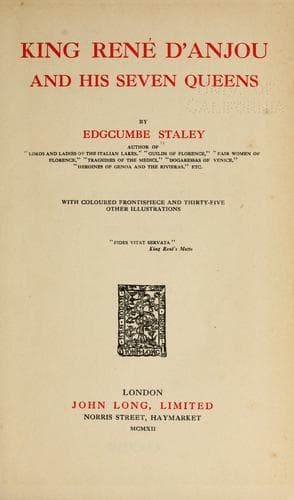
King René d'Anjou and His Seven QueensStaley, Edgcumbe
History
King René d'Anjou and His Seven Queens
Staley, Edgcumbe
France -- Court and courtiers; René I, King of Naples and Jerusalem, 1409-1480
“Love Lady-Day” was the quaint if somewhat hypocritical name bestowed
by general consent upon March 25, 1458. On that auspicious Lady-Day a
very notable assemblage gathered together at the Palace of Westminster.
The Queen had personally summoned the leaders of the rival factions
to meet the King and accompany him and herself in procession to St.
Paul’s, to crave from on high the spirit of conciliation. The streets
were crowded with loyal and appreciative citizens, whose delight knew
no bounds as they witnessed pass before them the King in his crown, his
horse’s bridle held by a “White Rose” knight and a “Red.” Then followed
the Queen in a litter, escorted by the new Duke of York, Somerset hand
in hand with Salisbury, Essex with Warwick, and others in order of
precedence. No man was armed, no woman feared, and joy-bells tossed
themselves over and over again, swung by stalwart ringers. _Te Deum_
was sung, but as the progress turned westward rumblings of thunder made
wise-acres shake their heads,--and in sooth they had good cause, as
matters chanced,--at the dire omen.
Warwick was the _bête noire_ of the reconciliation. By instinct and
preference a plotter-royal, he incurred the Queen’s suspicion by a
system of sea-piracy he established, and because of inconsiderate
language about the elder line of Plantagenet. An unfortunate street
fracas led to Warwick’s imprisonment. He was too proud to plead
guilty, the Queen too jealous to release him. York and Salisbury at
once enrolled their retainers, and stood ready to deliver Warwick.
The fruits of the reconciliation fell instantly to the ground, and
the complement of “Love Lady-Day” was renunciation and conflict _à
l’outrance_. Before the fresh outbreak of hostilities, whilst the
King retired for rest and quietude to St. Albans Abbey, the Queen,
accompanied by the baby Prince, made a progress through the Midlands.
The child’s winning ways touched every heart, and when he distributed
to struggling hands everywhere the cognizance of his patron saint,
St. Edward,--little silver swans,--everybody swore to be his henchman
and to stand by Henry and Margaret. Salisbury hung upon the skirts
of the Queen’s cortège, and Margaret inquired his business. His curt
reply determined her to demand his body, alive or dead. At Bloreheath
adherents of both sides met, and then Margaret had her baptism of
blood; her own was tinged with warriors’ strains from Charlemagne of
old, and in her veins the old lion sprang up phœnix-like. Margaret saw
red. She offered two courses only to her rebellious and disaffected
subjects, submission or death--no quarter. Alas! her experience was the
common one, the faithlessness of friends.
Public-domain text, read in full here on John Shaqi.
Reviews
Reviews
No reviews yet
Be the first to share your thoughts on this work.
Elsewhere in the archive
Join the Discussion
Join the discussion
Sign in to leave a comment or review.
Sign InorCreate an account