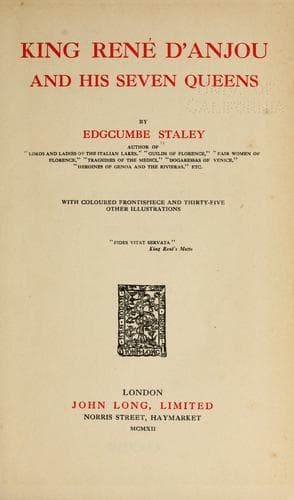
King René d'Anjou and His Seven QueensStaley, Edgcumbe
History
King René d'Anjou and His Seven Queens
Staley, Edgcumbe
France -- Court and courtiers; René I, King of Naples and Jerusalem, 1409-1480
Margaret caught the Duke by the arm as he was about to give the kiss
of etiquette. “Thanks, my cousin,” she said; “now I am, perhaps,
in no fit mind for compliments. I seek your aid for Henry and our
son, and I beseech you, by the love of Our Lady, not to credit the
abominable tales which have been circulated touching me.” The Duke
did not commit himself, but generously gave his “sweet cousin” 2,000
golden crowns,--wherewith “to fit your Majesty with proper raiment,”
he said,--and a fine diamond to wear for him. The next day the Duchess
of Bourbon, Philippe’s sister, visited Queen Margaret, and in her she
found a sincere and sympathizing confidante. She set before the Duchess
all the sad facts of her impoverished condition, and told her all about
the hardships she and her spouse and son had met with in England. “We
were reduced,” she said, “on one occasion to one herring among three,
and not more bread than would suffice for five days’ nourishment.”
She went on to say that once at Mass, at Dunfermline, she had no coin
for the offertory, and she asked an archer of the King of Scotland,
kneeling near her, for a farthing, which he most reluctantly gave her.
“Alas!” replied the weeping Duchess, “no Queen save your Majesty has
been so hardly dealt with by Providence; but now we must offer you,
sweet cousin, some consolation for your sufferings.” One more affecting
speech of the heroic Queen must be recorded. “When on the day of my
espousal,” she said, “I gathered the rose of England, I was quite well
aware that I should have to wear it whole with all its thorns!”
The Duchess, true to her word, organized splendid fêtes at the Castle
of St. Pol in honour of the royal refugees, and Margaret, now attired
as became her lofty station, put on one side her cruel anxieties, and
yielded herself to the pleasures and humours of the festivities. They
put her in mind of the gay tournaments in her happy home--the Court of
her good father, King René.
Henry was all the while a prisoner in the Tower, and Margaret’s tender
heart bled on his account. She for the moment was without resources,
and she had to bide her time. She knew that that time would come, and
never for a moment did she lend herself to unprofitable despair. The
Duke stood by her, a friend in need, and bestowed both money and an
escort upon his royal visitor. In the spring of 1463 she and the Prince
were welcomed in Bar-le-Duc by King René and his Court, though it cost
Margaret a pang to see her one-time Maid of Honour, Jehanne de Laval,
in her dear mother’s place.
Six months passed all too swiftly under the hospitable roofs of her
brother Jean, Duke of Calabria, and now actual Duke of Lorraine as
well, and of her sister Yolande, Countess of Vaudémont. Then widowed
Queen Marie sent an urgent summons for her favourite niece to pay her
a visit at Amboise in Touraine, and there most happily Margaret forgot
her troubles, and looked more hopefully than ever to the future.
Public-domain text, read in full here on John Shaqi.
Reviews
Reviews
No reviews yet
Be the first to share your thoughts on this work.
Elsewhere in the archive
Join the Discussion
Join the discussion
Sign in to leave a comment or review.
Sign InorCreate an account