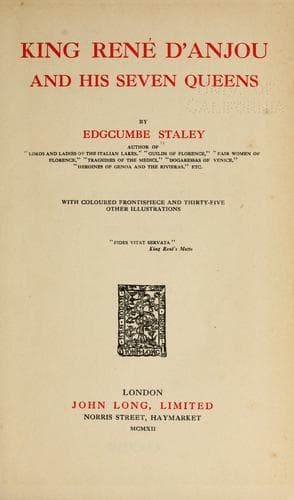
King René d'Anjou and His Seven QueensStaley, Edgcumbe
History
King René d'Anjou and His Seven Queens
Staley, Edgcumbe
France -- Court and courtiers; René I, King of Naples and Jerusalem, 1409-1480
The Earl of Warwick, accompanied by the Duke of Clarence, grandson
of King Henry IV., departed immediately for England, to make good his
brave words and prove his loyalty. His proclamation in favour of Henry,
Margaret, and Edward, produced an immense sensation, and in a couple of
days he found himself in command of 70,000 men, all crying, “A Henry! A
Henry!” Edward IV. immediately left the capital and sought the friendly
shores of Holland, and Warwick was, without a blow being struck, master
of the kingdom. His first step was to send the Bishop of Winchester to
the Tower, to clothe King Henry in regal robes, and conduct him with
the Sovereign’s escort to the Palace of Westminster. On October 13 the
King went to St. Paul’s, wearing once more his crown. Louis ordered
_Te Deum_ to be sung in every church in France, and went in person to
the Castle of Saumur to salute Queen Margaret. Early in November the
Queen, with the Prince and Princess of Wales and a very distinguished
following, set out for Paris, on their way to London. Every town
through which the royal cortège passed was gaily decorated, and the
hearty plaudits of the thronging inhabitants were mingled with the joy
peals of all the bells.
Harfleur once more was fixed upon as the port of passage, and once
more the Channel churned and a tempest fell upon the royal flotilla.
Nobody has been able to explain why Margaret of England was so
persistently persecuted by the divinities of the weather. Twice they
put back to port, and then, after tossing about for sixteen whole days
and nights, they made Weymouth,--a passage ordinarily of no more than
as many hours,--and landed on April 13. That day was indeed ill-omened
for the cause Queen Margaret had at heart, and for which she had
suffered such appalling vicissitudes. The Battle of Barnet was fought
and lost; Warwick was killed, and King Henry was again a prisoner.
Verily, Queen Margaret’s star was a blaze of disasters!
The terrible news staggered the courageous Queen; she swooned, but
soon recovered her usual equanimity, although out of the bitterness
of her soul she sobbed: “Better die right out, methinks, than exist
so insecurely!” She appeared to have no plan of action, for such a
disaster seemed to be impossible; so, to gain time for thought and
effort, she moved herself and those she loved into the safe sanctuary
of Beaulieu Abbey. There Somerset and many other notable fugitives
forgathered. To them she counselled retreat--“Till Providence,” she
said, “ordereth better luck.” The Prince now for the first time
asserted himself, and, with his mother’s daring, gave an emphatic “No.”
At Bath a goodly array of soldiers rallied to the royal standard, and
Margaret determined to cross the Severn and join her forces to Jasper
Tudor’s army of sturdy loyal Welshmen. The Duke of Gloucester opposed
her advance, and so she turned aside to Tewkesbury, and there encamped.
Public-domain text, read in full here on John Shaqi.
Reviews
Reviews
No reviews yet
Be the first to share your thoughts on this work.
Elsewhere in the archive
Join the Discussion
Join the discussion
Sign in to leave a comment or review.
Sign InorCreate an account