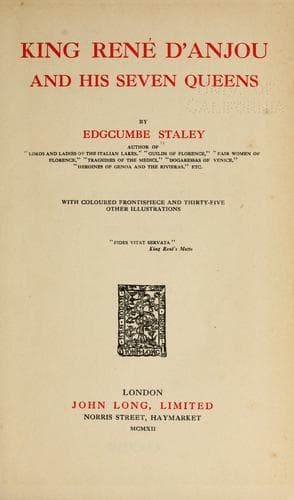
King René d'Anjou and His Seven QueensStaley, Edgcumbe
History
King René d'Anjou and His Seven Queens
Staley, Edgcumbe
France -- Court and courtiers; René I, King of Naples and Jerusalem, 1409-1480
The “Bringing in the Champion’s Crest” was a remarkably pretty
ceremony. The “Queen of Beauty,” attended by two maids of honour, all
clad in full state robes, with towering _hennins_, and wearing superb
jewels and ornaments, were escorted to a chamber of preparation, within
the castle, immediately before the closing banquet of the tournament.
There a procession was marshalled; pages of the contestant knights,
arrayed in their proper colours and wearing ermine mantles, danced
gaily before the “Queen of Beauty,” and knelt as she advanced, bearing
the flashing crest upon an embroidered scarf. Pursuivants, heralds, and
kings-of-arms, swelled the glittering progress with tabards, wands,
and crowns. Masters of the ceremony were in attendance on the “Queen.”
All moved with grace and dignity to the banqueting-hall, which they
traversed up to the royal daïs, accompanied by attendants bearing great
flaring torches and waxen candles. Everybody rose at the entry of the
procession, and the Prince of highest rank handed the “Queen” to her
special seat, whence she might receive the homage of the knightly
company, and bestow upon the champion the crest she bore. Strident
music and the blare of brazen horns filled the great hall, and the
high-pitched roof re-echoed the plaudits of the company.
The “Grand Prix” was gained neither by King René nor by King Charles.
The former, indeed, caused a sensation by appearing in black tournament
armour, his shield studded with silver spangles; his lance was black,
and his charger caparisoned in a black housing, which trailed the
ground. René was mourning still for his good mother, Queen Yolande, and
for his second son of promise rare, Louis, Marquis of Pont-à-Mousson.
The “Champion of Champions” was not the Count of Nevers,--perhaps
to Jehanne’s regret,--but Louis de Beauvau; whilst the second prize
fell to Robert de Florigny, and the third to Ferri de Vaudémont.
These famous tournaments did not lack the assistance by illustration
of painters; Jehannot le Flament,--better known nowadays as Jan van
Eyck,--King René’s master at Bar-le-Duc, was in attendance on his royal
pupil, and painted at least two considerable pictures of the pageants.
Alas! those valuable paintings are lost to us.
Public-domain text, read in full here on John Shaqi.
Reviews
Reviews
No reviews yet
Be the first to share your thoughts on this work.
Elsewhere in the archive
Join the Discussion
Join the discussion
Sign in to leave a comment or review.
Sign InorCreate an account